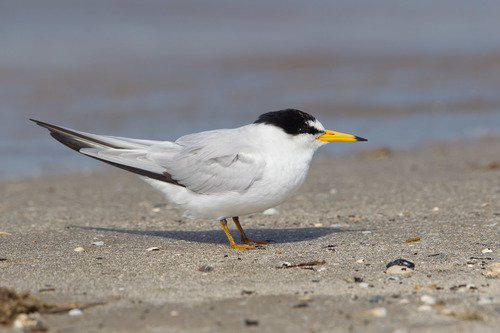
Least Tern
Sternula antillarum
The smallest of the American terns, this acrobatic bird is a master of the plunge-dive and a spirited defender of the shoreline. With its striking white forehead and needle-sharp bill, the Least Tern is a favorite for coastal birdwatchers and nature photographers alike.
Quick Identification
Size
Length: 8.3–9.1 in (21–23 cm); Wingspan: 18.9–20.9 in (48–53 cm); Weight: 1.1–1.6 oz (30–45 g)
Colors
Pale gray wings and back, white underparts, black cap with a prominent white triangular forehead patch; yellow bill usually tipped with black, and orange-yellow legs.
Key Features
- Smallest North American tern
- Distinctive white triangular forehead patch
- Bright yellow bill with a black tip
- Deeply forked tail
- Quick, shallow wingbeats unlike larger terns
When You’ll See Them
Geographic range
Where Does the Least Tern Live?
The Least Tern is native to North America, where it occupies a vast breeding range spanning from the Atlantic and Gulf coasts to the interior river systems of the Great Plains, such as the Mississippi and Missouri rivers. As a migratory species, it moves south for the winter, populating the coastal regions of Central America, the Caribbean islands, and the northern shores of South America, including Venezuela and Colombia. While they are widespread, their populations are often concentrated in localized pockets where protected, disturbance-free beach habitat remains available.
Basemap © OpenStreetMap contributors
Behavior
Least Terns are highly social, energetic birds known for their graceful yet frantic flight patterns. They are colonial nesters, often gathering in large groups on open sand or gravel to raise their young. Their most iconic behavior is the plunge-dive: they hover several feet above the water’s surface, pinpointing small fish before tucking their wings and diving headlong into the water with precision. This species is also famous for its courtship rituals, which involve the male presenting a "gift" of a small fish to the female during aerial displays and ground-based strutting.
While they are relatively small, Least Terns are incredibly protective of their nesting sites. When a predator or an unaware human approaches a colony, the birds will take to the sky en masse, emitting sharp, metallic "kip-kip-kip" calls and performing aggressive dive-bombing maneuvers to drive the intruder away. This communal defense is vital for their survival, as their eggs are laid in simple scrapes on the ground and are extremely vulnerable to terrestrial predators.
EverydayEarth exclusive
Camera Tips
Capturing the Least Tern on a backyard or trail camera is a unique challenge because of their preference for wide-open, sandy environments. If you live near a coastal area or a major river system where these birds are known to frequent, the best placement for your camera is on a low-profile ground mount. Setting the camera just 6 to 12 inches off the ground provides an intimate, eye-level perspective of their nesting and "loafing" behaviors. Ensure your camera is pointed toward open sandy patches or areas just above the high-tide line, but never place equipment inside an active nesting colony, as this can lead to nest abandonment.
Because Least Terns are incredibly fast, you will need a camera with a high-speed trigger and a fast recovery time. If your device allows for manual settings, prioritize a high shutter speed to freeze the action of their rapid wingbeats. If you are using a video-capable AI camera, look for spots near the water's edge where they might land to rest or preen. These "loafing" spots are often used repeatedly by the colony, making them ideal locations for consistent captures without disturbing the birds during the sensitive incubation period.
Timing is critical for this species; in North America, you’ll find them most active from May through July. During this window, the early morning light (6-9 AM) offers the best illumination for their pale plumage and prevents the harsh glare that sand can create in midday sun. While baiting with food isn't effective for these live-prey hunters, you can sometimes attract them to a specific view-frame by placing a small piece of driftwood or a flat stone in an otherwise featureless sandy area, as they occasionally use these as perches or landmarks.
Similar Species
Species that look similar or are commonly confused with Least Tern.
Little Tern
Found in the Old World; nearly identical but has a slightly different call and subtle wing feather differences.
Forster's Tern
Much larger than the Least Tern, with an orange bill tipped in black and lacking the white forehead patch during the breeding season.
Common Tern
Larger with a longer bill and deeper wingbeats; it lacks the Least Tern's yellow bill and white forehead triangle.
Frequently Asked Questions
Record Least Tern at your habitat
Connect a camera to start building your own species record — AI identifies every visitor automatically.