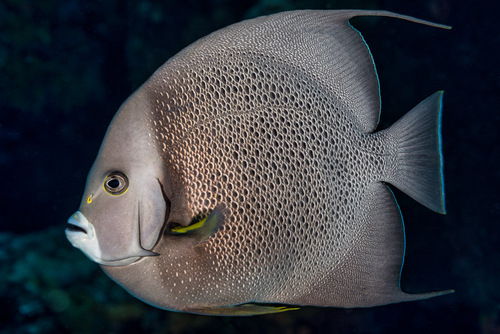
Grey Angelfish
Pomacanthus arcuatus
The Grey Angelfish is the 'friendly face' of the Atlantic reefs, known for its curious personality and striking silver-grey scales. Usually seen in devoted pairs, these elegant grazers are a favorite for underwater photographers.
Quick Identification
Size
Typically 35-50 cm (14-20 inches) in length, with a maximum size of 60 cm (24 inches) and weighing up to 1.8 kg (4 lbs).
Colors
Adults are a uniform grey to brownish-grey with a dark spot on each scale; mouth is white; pectoral fins have a yellow inner surface. Juveniles are black with five vertical yellow bands.
Key Features
- Deep, disc-shaped and highly compressed body
- Dorsal and anal fins ending in long, elegant filaments
- Uniformly greyish scales with dark centers creating a mesh effect
- Prominent white-ringed mouth on a lighter grey face
When You’ll See Them
Sightings on EverydayEarth
Aug 1, 2026
A vibrant reef scene where a bright Blue Chromis swims across the foreground, while a pair of Grey Angelfish navigate through the sea fans and sponges on the left side of the frame. Several smaller fish dart in and out of the complex coral structures in the background.
Jul 30, 2026
The underwater reef is bustling with life. A large Grey Angelfish glides behind swaying sea fans near the center of the frame. Small, vibrant Blue Chromis hover in the water column above the coral, while a slender Caribbean Bluehead Wrasse swims quickly across the scene.
Jul 16, 2026
A vibrant underwater scene at a coral reef. A Grey Angelfish swims gracefully across the center-left, while several small, bright Blue Chromis dart among the swaying sea fans and reef structures. In the upper portion of the frame, a Creole Wrasse is seen swimming through the open water.
Jul 7, 2026
A Grey Angelfish swims leisurely through the reef environment, appearing prominently in the center of the frame. In the background, numerous smaller reef fish are active among the various corals and sea fans, which sway gently in the underwater current.
Jul 3, 2026
Various reef fish are active around the coral head. A Grey Angelfish swims across the upper water column while several small Blue Chromis hover and dart above the reef structure. Sunlight filters through the water, illuminating the diverse coral and sea fans.
Jul 3, 2026
A vibrant underwater scene on a coral reef. A Creole Wrasse swims prominently across the upper-middle of the frame, while several bright Blue Chromis hover in the water column. In the background, a large Grey Angelfish passes through the scene, and various other reef fish are visible around the diverse coral and sea fan structures.
Geographic range
Where Does the Grey Angelfish Live?
The Grey Angelfish is a native resident of the warm tropical and subtropical waters of the Western Atlantic Ocean. Its range begins as far north as the coastal waters of New England and New York—though they are rare visitors there—and extends southward through the Caribbean and Gulf of Mexico all the way to Rio de Janeiro, Brazil. They are most consistently found in the coral-rich environments of the Bahamas, the Florida Keys, and the various island nations of the Antilles.
Basemap © OpenStreetMap contributors
Behavior
The Grey Angelfish is one of the most charismatic inhabitants of the reef, known specifically for its bold and inquisitive nature. Unlike many reef fish that dart away at the sight of humans, these fish often approach divers and snorkelers, seemingly curious about their presence. They are most commonly seen in pairs, as they form strong, monogamous bonds that often last for the duration of their lives. These pairs work together to defend a feeding territory against other angelfish.
Strictly diurnal, the Grey Angelfish is active throughout the day, spending its time methodically grazing on the reef. Their movement is slow and graceful, utilizing their large, wing-like fins to hover and pivot in tight spaces within the coral architecture. As the sun sets, they become much more secretive, retreating into the labyrinthine crevices of the reef to hide from nocturnal predators like sharks and large groupers.
EverydayEarth exclusive
Camera Tips
Capturing the Grey Angelfish on camera requires an underwater setup, such as a GoPro or an AI-powered aquatic housing. To get the best shots, position your camera near large barrel sponges or vertical reef walls where the fish are likely to graze. Because Grey Angelfish are curious, they are excellent subjects for stationary cameras; they will often swim directly up to the lens to investigate their own reflection, providing high-detail 'selfies' that are rare with other species.
Lighting is your biggest obstacle under the waves. As you go deeper, the water filters out red light, leaving your footage looking washed out and blue. Use a red filter on your lens or external video lights to restore the natural grey, brown, and yellow hues of the fish. If using an AI-powered camera, ensure the white balance is set to 'Underwater' mode to help the software distinguish the fish's silver-grey body from the blue background.
Placement is key for behavior shots. Look for 'cleaning stations'—areas where small gobies or shrimp hang out. Grey Angelfish will often hover motionless in these spots to have parasites removed, offering a perfect opportunity for stable, long-duration footage. Use a weighted tripod or a heavy sandbag mount to keep the camera steady against the ocean surge. If you are setting the camera for time-lapse, a 1-second interval is ideal to capture their slow, rhythmic swimming patterns without missing the subtle movements of their trailing fin filaments.
Similar Species
Species that look similar or are commonly confused with Grey Angelfish.
Frequently Asked Questions
Record Grey Angelfish at your habitat
Connect a camera to start building your own species record — AI identifies every visitor automatically.