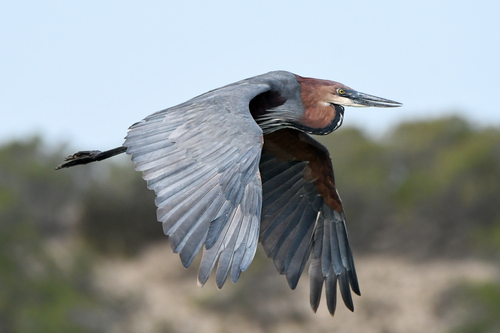
Goliath Heron
Ardea goliath
The undisputed king of the shallows, the Goliath Heron is a prehistoric-looking giant that rules Africa's waterways with silent, statuesque patience.
Quick Identification
Size
Length 120-152 cm (47-60 in), Wingspan 185-230 cm (73-90 in), Weight 4-5 kg (8.8-11 lb)
Colors
Slate-grey upperparts with rich chestnut-red on the head, neck, and underparts; white throat and a massive, dark, dagger-like bill.
Key Features
- The world's largest heron standing up to 5 feet tall
- Deep chestnut plumage on the head and neck contrasting with a slate-grey back
- Massive, heavy bill measuring up to 10 inches long
- Slow, heavy wingbeats in flight with legs trailing far behind
When You’ll See Them
Sightings on EverydayEarth
Aug 2, 2026
A Goliath Heron stands motionless in the shallow water, a typical hunting posture for this large wading bird as it waits for fish to pass within reach.
Aug 2, 2026
A Goliath Heron stands patiently on one leg in the shallow water of a watering hole, occasionally turning its head to scan the area for prey.
Aug 2, 2026
A Goliath Heron stands motionless in shallow water, scanning for prey. It briefly moves its head and takes a small, deliberate step, demonstrating typical slow-moving hunting behavior.
Aug 2, 2026
A Goliath Heron stands motionless on a large rock in the foreground, keeping a watchful eye on the water for potential prey. In the surrounding river, a large pod of hippopotamuses rests mostly submerged, with their broad backs and heads occasionally breaking the surface as they twitch their ears and breathe.
Jul 31, 2026
A Goliath Heron stands perfectly still in the shallow water, likely hunting for fish. As the camera pans across the river, it reveals a pod of Common Hippopotamuses resting together, with several partially submerged in the channel and others visible near the bank.
Jul 31, 2026
A Goliath Heron stands motionless in the shallow water of the watering hole. It remains alert, slowly turning its head to scan for prey or potential threats in its environment.
Geographic range
Where Does the Goliath Heron Live?
Native to the African continent, the Goliath Heron is most commonly found throughout sub-Saharan Africa, with particularly high densities in the Great Lakes region and the Nile River basin. Beyond Africa, small and increasingly rare populations exist in Southwest Asia, specifically in the marshes of Iraq and coastal areas of Iran and Pakistan. While it is a resident across most of its range, it is highly dependent on permanent wetlands and may shift its territory based on water availability in arid regions.
Basemap © OpenStreetMap contributors
Behavior
The Goliath Heron is a solitary and stoic giant of the wetlands. Unlike smaller herons that may forage in groups, this species is highly territorial and usually seen alone, standing motionless for hours in shallow water. Its hunting strategy is the epitome of patience; it waits for large prey to come within reach before delivering a powerful, lightning-fast strike with its massive bill. Due to its size, it can wade into deeper waters than most other wading birds, giving it access to larger fish that are out of reach for its cousins.
Despite its imposing size, the Goliath Heron is surprisingly shy and wary of human presence. When disturbed, it takes flight with a deep, croaking bark that can be heard from a great distance, moving with slow, ponderous wingbeats. It is not a migratory bird in the traditional sense, but it will move locally to find permanent water sources during dry seasons. Interactions with humans are rare, though it is a prized sight for birdwatchers and photographers due to its prehistoric appearance and regal stature.
EverydayEarth exclusive
Camera Tips
Capturing the Goliath Heron on camera requires a strategic approach because of its immense size and its preference for deep wading. Position your camera on a sturdy tripod or mount near the edge of a permanent water body, such as a lake shore or a slow-moving river bank. Because this bird stands nearly five feet tall, you should angle the camera slightly upward if it is placed low to the ground, or set it at chest height (about 3-4 feet) to ensure you don't just capture its legs. A wide-angle lens is often better than a tight crop to capture the full majesty of its wingspan if it takes flight.
Baiting is generally not recommended for this species, but you can increase your chances by placing the camera near 'sentinel' spots—exposed logs or shallow sandbars where the heron may stand to preen or sun itself. These birds are creatures of habit and will often return to the same fishing spot day after day. Since they move very slowly while hunting, you don't need an ultra-fast trigger speed, but you should enable 'burst mode' or high-frequency photo capture to catch the exact moment of a strike, which happens in a flash.
The best time for lighting is during the 'golden hours' of early morning and late afternoon when the chestnut plumage of the heron truly glows against the blue water. Use a high-quality PIR (passive infrared) sensor setting to avoid false triggers from moving reeds or water ripples. If your camera supports video, set it to record at least 20-30 second clips; the slow-motion grace of a Goliath Heron taking flight is one of the most spectacular sights in the avian world.
Similar Species
Species that look similar or are commonly confused with Goliath Heron.
Grey Heron
Much smaller with a white and black neck, lacking the deep chestnut tones of the Goliath.
Purple Heron
Significantly smaller and more slender with a more intricate, striped neck pattern and darker overall plumage.
Great Blue Heron
Found in North America, it has a white crown and black eyebrow, unlike the solid chestnut head of the Goliath.
Frequently Asked Questions
Record Goliath Heron at your habitat
Connect a camera to start building your own species record — AI identifies every visitor automatically.