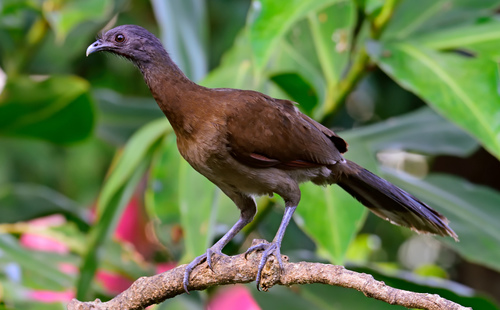
Gray-headed Chachalaca
Ortalis cinereiceps
The Gray-headed Chachalaca is the charismatic 'social butterfly' of Central American gardens. Known for its loud, rhythmic morning calls and acrobatic tree-hopping, this unique bird brings a sense of wild energy to any backyard trail camera.
Quick Identification
Size
48–54 cm (19–21 in) in length; weighs approximately 430–600 g (0.9–1.3 lbs).
Colors
Dull olive-brown body with a distinct slate-gray head and neck; flight feathers are a noticeable rufous-brown.
Key Features
- Slate-gray head and neck contrasting with olive body
- Long, dark tail with pale or white tips
- Rufous primary wing feathers visible in flight
- Slender, chicken-like profile with a long neck
When You’ll See Them
Sightings on EverydayEarth
Jul 29, 2026
A Gray-headed Chachalaca is perched on a wooden platform feeder, feeding on sliced citrus and other fruits. It remains on the feeder through a technical video glitch that occurs halfway through the clip.
Jul 24, 2026
A Crimson-backed Tanager is seen feeding on fruit on the left side of the platform. Moments later, a much larger Gray-headed Chachalaca enters from the right, jumping onto the feeder and fanning its tail as it approaches the fruit. The smaller tanager flies to a nearby branch to watch as the chachalaca begins to eat.
Jul 22, 2026
A vibrant variety of birds visits the fruit feeder in the lush Panamanian rainforest. A Red-crowned Woodpecker occupies the center of the platform, feeding on fruit. Above the tray, a Gray-headed Chachalaca perches quietly on a branch. During the scene, a Blue-gray Tanager arrives on the right side of the feeder, followed briefly by a tiny Bananaquit that joins the others to forage.
Jul 22, 2026
A Gray-headed Chachalaca is perched prominently on a mossy branch in the foreground, looking around with its head turned. On the fruit tray below, a Clay-colored Thrush and a male Crimson-backed Tanager land to feed on the oranges and bananas.
Jul 17, 2026
Several Gray-headed Chachalacas visit a forest fruit feeder. One bird perches on the metal tray to feed on orange slices, while others are seen on the mossy logs and branches behind the feeder. One bird lands on the tray during the sequence, joining the one already eating.
Jul 15, 2026
A Gray-headed Chachalaca and a Clay-colored Thrush are seen feeding together on a platform filled with various fruits like bananas and oranges. The Chachalaca, much larger than the thrush, carefully selects pieces of fruit from the left side of the feeder, eventually picking up a large chunk of banana and swallowing it. The thrush stays on the right side, occasionally pecking at the citrus slices.
Geographic range
Where Does the Gray-headed Chachalaca Live?
The Gray-headed Chachalaca is a signature species of the Central American tropics. Its native range stretches from the Caribbean slopes of eastern Honduras southward through Nicaragua, Costa Rica, and Panama, eventually reaching the northwestern corner of Colombia in South America. They are typically found in humid lowland environments where lush vegetation provides both cover and a steady supply of fruit.
Basemap © OpenStreetMap contributors
Recorded on EverydayEarth
Behavior
The Gray-headed Chachalaca is a highly social bird, almost always found in noisy family groups of 6 to 12 individuals. They are famous for their raucous, rhythmic vocalizations, which often erupt into a synchronized chorus at dawn and dusk. While they are capable of flight, they prefer to move through the canopy by hopping and running along branches with incredible agility, looking much like 'arboreal chickens.'
These birds are remarkably adaptable and have learned to coexist with humans in suburban areas and coffee plantations. They are often seen performing acrobatic maneuvers to reach hanging fruit or social grooming within their group. Though they can be shy in deep forests, they become quite bold in backyards where they are regularly fed, often establishing a daily routine that brings them to the same feeding spot at the same time every morning.
EverydayEarth exclusive
Camera Tips
To capture the best footage of Gray-headed Chachalacas, mount your camera at a height of 3 to 5 feet. While they spend much of their time in the canopy, they frequently descend to lower branches or the ground to forage for fallen fruit. Aiming your camera at a flat platform feeder or a clear patch of ground near dense shrubs will yield the most consistent results. Because they travel in tight-knit groups, use a wider field of view to capture the social interactions of the entire flock rather than just one bird.
Attracting them is relatively simple if you live within their range: they are highly motivated by overripe fruit. Bananas, papaya, and plantains are irresistible to them. Secure the fruit to a branch or place it on a heavy tray to prevent the birds from dragging it out of the camera's frame. Their large size and energetic movements mean they can easily knock over lightweight equipment, so ensure your camera is firmly mounted to a post or tree trunk.
Lighting and timing are key for this species. They are most active at the crack of dawn, often being the first birds to start 'shouting' as the sun rises. Set your camera to be most sensitive during these early hours. Because their feathers are relatively dark and muted, try to position the camera so it isn't shooting directly into the morning sun, which can wash out the subtle gray and olive tones of their plumage. High-speed video mode is also recommended to capture their quick, hopping movements through the brush.
Similar Species
Species that look similar or are commonly confused with Gray-headed Chachalaca.
Plain Chachalaca
Found from Texas to Nicaragua; lacks the distinct slate-gray head and has more uniform brownish-tan plumage.
Rufous-vented Chachalaca
Found in Colombia and Venezuela; distinguished by the bright rufous-brown patch under the tail (the vent).
Crested Guan
Much larger and darker with a noticeable crest and a red throat wattle, unlike the smaller, crestless Chachalaca.
Frequently Asked Questions
Record Gray-headed Chachalaca at your habitat
Connect a camera to start building your own species record — AI identifies every visitor automatically.