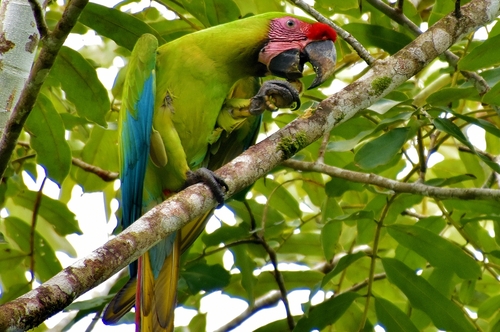
Great Green Macaw
Ara ambiguus
A vibrant emerald icon of the Central American rainforest, the Great Green Macaw is one of the world's largest and most endangered parrots. Seeing their massive wingspan and hearing their prehistoric calls is a rare privilege for any nature enthusiast.
Quick Identification
Size
Length: 85–90 cm (33–35 in); Wingspan: approx 115 cm (45 in); Weight: 1.3 kg (2.9 lbs)
Colors
Primarily lime-green plumage, scarlet-red forehead, pale blue lower back and wing feathers, and reddish-orange tail with blue tips.
Key Features
- Massive black hooked beak
- Vivid scarlet-red forehead patch
- Lime-green body with yellowish tint
- Large size, often exceeding 33 inches in length
When You’ll See Them
Geographic range
Where Does the Great Green Macaw Live?
Native to the humid tropical lowlands of Central and South America, the Great Green Macaw spans a fragmented territory from eastern Honduras and Nicaragua through Costa Rica and Panama into northern Colombia. A rare and distinct subspecies also clings to survival in the dry forests of coastal Ecuador. Because of their specialized diet, they are rarely found far from the towering Dipteryx trees that define their primary habitat.
Basemap © OpenStreetMap contributors
Behavior
Great Green Macaws are highly social and intelligent birds, usually seen in pairs or small family groups. They communicate with loud, harsh squawks and screeches that can be heard from long distances across the canopy. In the wild, they are quite shy and wary of humans, often flying away if they sense a presence below their roosting trees.
Their daily routine revolves around foraging for specialized seeds and nuts. They are known for their seasonal movements, following the fruiting cycles of specific trees like the Almendro. Despite their size, they are remarkably agile flyers, navigating the dense rainforest canopy with grace. They form lifelong pair bonds and are dedicated parents, nesting high up in natural tree cavities.
EverydayEarth exclusive
Camera Tips
Capturing the Great Green Macaw on camera requires height and patience. Since these birds are canopy dwellers, a ground-level trail camera is unlikely to see them unless they are visiting a specific mineral lick or low-hanging fruit tree. If you have access to a safe way to mount cameras high in the trees (15–30 meters up), target the massive Almendro trees during their fruiting season. Aim the camera at known nesting cavities or horizontal branches where the birds often perch to crack open hard nuts.
Lighting is a major challenge in the dense rainforest. Set your AI-powered camera to a high shutter speed to freeze the action of their powerful wings, and ensure you are using a high-quality lens to capture the subtle yellow-greens of their plumage. Because they are most active in the early morning and late afternoon, configure your camera to trigger during these 'golden hours' when the light pierces through the canopy gaps.
Baiting is generally not recommended for these endangered birds to avoid habituation or disease transmission. Instead, focus on 'bottleneck' areas like water sources during the dry season or specific fruiting trees. If your camera allows for video, set it to record 15-30 second clips; the social interactions and loud vocalizations of a pair of macaws are far more captivating than a single still image. Check your camera housing for waterproofing, as the humid environment can lead to lens fogging.
Similar Species
Species that look similar or are commonly confused with Great Green Macaw.
Frequently Asked Questions
Record Great Green Macaw at your habitat
Connect a camera to start building your own species record — AI identifies every visitor automatically.