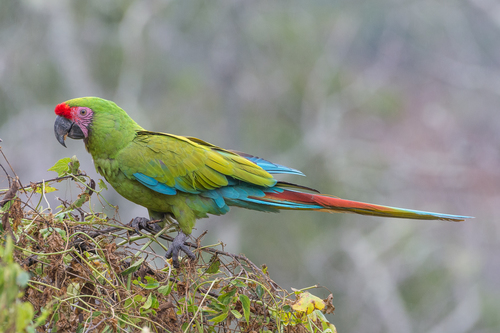
Military Macaw
Ara militaris
With their striking olive-green 'uniform' and brilliant red accents, Military Macaws are the emerald jewels of the mountain forests. These intelligent, long-lived parrots bring a splash of tropical color and a boisterous personality to the wooded canyons they call home.
Quick Identification
Size
Length: 70–85 cm (27.5–33.5 in); Wingspan: 99–110 cm (39–43 in); Weight: 900–1,100 g (2–2.4 lbs)
Colors
Primarily olive-green body with a bright red forehead patch. Flight feathers are light blue, and the long tail is red with blue tips. The face has a bare white patch with fine black feather lines.
Key Features
- Distinctive bright red forehead patch
- Large, powerful black hooked beak
- Mainly olive-green plumage with blue-tipped wings
- Long, pointed tail that is red and blue
When You’ll See Them
Geographic range
Where Does the Military Macaw Live?
The Military Macaw is native to the Americas, maintaining a large but highly fragmented range that stretches from the rugged mountains of Mexico down into the heart of South America. These parrots are primarily found along the Pacific slope of Mexico and in the eastern foothills of the Andes Mountains, spanning countries like Colombia, Venezuela, Peru, and Bolivia, with their southern limit reaching northern Argentina. Unlike some tropical parrots that stay in the lowland jungles, the Military Macaw often prefers higher altitudes and more arid, deciduous woodlands, making their home in the wooded canyons and cliffside forests of the interior highlands.
Basemap © OpenStreetMap contributors
Behavior
Military Macaws are highly social and intelligent birds, typically observed in pairs or small family groups. They are famous for their loud, raucous vocalizations that allow them to communicate across vast distances in the forest canopy. During the day, they exhibit a structured routine, leaving communal roosting sites at dawn to travel several miles to find food, returning just before dusk.
In the wild, these parrots are monogamous and form deep, lifelong bonds with their mates. They are often seen preening each other or flying in synchronized pairs. While they are generally shy and fly away at the sight of humans in remote areas, they can become quite bold in protected parks or suburban edges where food is plentiful. Their intelligence makes them highly curious, often investigating new objects or potential food sources with their dexterous feet and powerful beaks.
EverydayEarth exclusive
Camera Tips
Capturing a Military Macaw on your backyard camera requires thinking vertically. Since these birds spend the vast majority of their time in the upper canopy, a camera placed at eye level will likely only catch them if they descend for water or food. For the best results, mount your AI-powered camera high on a balcony, a second-story roofline, or a sturdy tree limb overlooking a clear flight path. Angling the camera 15-30 degrees downward ensures you capture the brilliant red and blue tail feathers as they land on a perch.
To lure these intelligent parrots into your camera’s field of view, offer high-value treats that require some work. Whole walnuts, almonds in the shell, and large striped sunflower seeds are irresistible to their powerful beaks. If you have the space, a platform feeder is much more effective than a hanging tube feeder, as macaws need a stable surface to stand on while they use their feet to manipulate food. Ensure the feeder is placed in a sunny spot; the AI recognition software will perform best when it can clearly distinguish the vivid green 'military' plumage against the background.
Timing is everything with this species. Military Macaws are most active during their 'morning commute' from roosting sites to feeding grounds, typically shortly after sunrise. Set your camera to take rapid-fire bursts or high-frame-rate video, as their arrival can be sudden and high-energy. If you live in a drier climate, a large, elevated bird bath can be a secret weapon for mid-day captures, as these birds often seek out water to cool off and drink during the heat of the afternoon.
Similar Species
Species that look similar or are commonly confused with Military Macaw.
Frequently Asked Questions
Record Military Macaw at your habitat
Connect a camera to start building your own species record — AI identifies every visitor automatically.