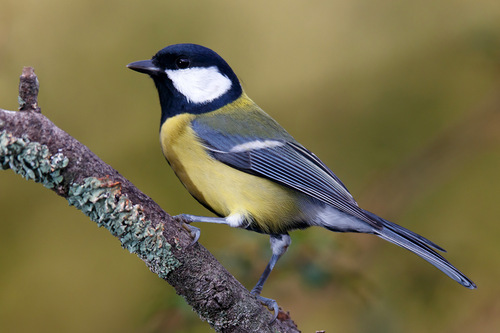
Great Tit
Parus major
With its striking black-and-yellow plumage and cheerful 'teacher-teacher' song, the Great Tit is one of the most recognizable and charismatic visitors to any backyard. A master of adaptation, this bold little bird brings life and energy to gardens across Europe and Asia year-round.
Quick Identification
Size
Length: 12.5–14 cm (5–5.5 in); Wingspan: 23–26 cm (9–10 in); Weight: 16–22 g (0.5–0.8 oz)
Colors
Glossy black cap and throat, white cheeks, olive-green back, and bright yellow underparts. Males feature a thick black vertical 'tie' down the breast, while females have a thinner, often broken line.
Key Features
- Glossy black head and throat with stark white cheek patches
- Bright yellow breast with a central black vertical stripe
- Olive-green back with blue-gray wings and tail
- Distinctive 'saw-sharpening' two-note call
When You’ll See Them
Geographic range
Where Does the Great Tit Live?
The Great Tit is an incredibly successful species found across nearly the entire European continent, stretching from the British Isles across to Scandinavia and down to the Mediterranean. Its reach extends through North Africa and across the Middle East into Central Asia and the Amur River region. While they are mostly resident across this vast territory, northern populations may move south during particularly brutal winters to find more reliable food sources.
Basemap © OpenStreetMap contributors
Behavior
Great Tits are remarkably adaptable and bold birds, often the first to explore new feeders or nesting sites in a garden. They are highly social, especially outside of the breeding season when they join mixed-species foraging flocks. However, they are also known for their assertive nature; they can be dominant and even aggressive towards smaller birds like Blue Tits when competing for prime food sources.
Known for their intelligence, Great Tits are famous for their ability to learn and pass on new behaviors, such as the historic habit observed in the UK where they learned to pierce foil milk bottle tops to reach the cream. Their vocalizations are diverse and complex, featuring a wide repertoire of songs and calls. During the breeding season, they are dedicated cavity nesters, readily accepting man-made birdhouses and raising large, hungry broods.
EverydayEarth exclusive
Camera Tips
To capture the best footage of Great Tits, position your AI-powered camera near a hanging bird feeder or a bird bath. They are particularly fond of sunflower hearts and suet blocks, which provide the high energy they need. Mount the camera at eye level (about 1.5 meters off the ground) and aim for a distance of 60-90 cm from the feeder to get crisp, clear details of their striking yellow plumage and black 'tie.' Using a camera with a fast trigger speed is essential, as these birds move quickly and rarely stay still for long.
If you have a nesting box, this is the ultimate spot for a camera setup. Great Tits are frequent residents in standard small-hole boxes (32mm entry). Placing a camera inside the roof of the box or focused on the entrance hole during the spring months (March to June) will allow you to document everything from nest building with moss and hair to the frenetic feeding of chicks. Ensure the camera has a macro lens or a close-focus setting for these tight spaces to avoid blurry images of the nestlings.
During the winter, Great Tits are very active in the early morning as they need to replenish calories lost during cold nights. Set your camera to be most active from sunrise through the first three hours of the day. In the summer, they are great for 'action shots' as they hunt for caterpillars in nearby foliage; placing a camera near a shrubby area or a caterpillar-rich oak tree can yield unique hunting behavior videos. Since they are bold, they rarely mind the presence of a camera, so you don't need much camouflage, but ensuring the unit is rock-steady will prevent motion-blurred shots during their rapid movements.
Similar Species
Species that look similar or are commonly confused with Great Tit.
Blue Tit
Much smaller with a bright blue cap and no black vertical stripe on the yellow breast.
Coal Tit
Smaller and more drab, with a white patch on the back of its black neck and no yellow on its belly.
Marsh Tit
Lacks the yellow belly and black breast stripe, featuring a plain brown back and a much smaller black bib.
Frequently Asked Questions
Record Great Tit at your habitat
Connect a camera to start building your own species record — AI identifies every visitor automatically.