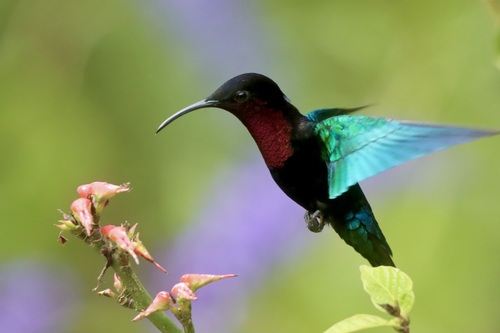
Purple-throated Carib
Eulampis jugularis
With its velvety black plumage and a throat that glows like a crushed amethyst, the Purple-throated Carib is the undisputed jewel of the Lesser Antilles.
Quick Identification
Size
Length 11.5–12 cm (4.5–4.7 in); Weight 7–12 g (0.25–0.42 oz)
Colors
Velvety black body with an iridescent purple-red throat; shimmering emerald green wings and tail.
Key Features
- Iridescent purple-red throat (gorget)
- Velvety black body plumage
- Emerald green wings and tail
- Long, downward-curving black bill
When You’ll See Them
Geographic range
Where Does the Purple-throated Carib Live?
This stunning hummingbird is a Caribbean specialist, native to the archipelago of the Lesser Antilles. Its core range spans the volcanic islands from Saba and St. Kitts in the north down through Dominica and St. Lucia to St. Vincent and Grenada in the south. While they are essentially permanent residents of these lush tropical islands, they are known to occasionally wander as vagrants to neighboring islands like Barbados.
Basemap © OpenStreetMap contributors
Behavior
The Purple-throated Carib is a bold and dominant presence in the tropical gardens and forests of the Lesser Antilles. Known for its intense territoriality, it often defends high-quality nectar sources from other hummingbirds with aggressive aerial displays and sharp, clicking vocalizations. You will frequently see them perched prominently on high, exposed branches when not feeding, keeping a watchful eye over their chosen flower patches.
Interestingly, this species exhibits significant sexual dimorphism in its foraging habits. Males, being slightly larger with shorter, straighter bills, tend to defend clumps of Heliconia caribaea. Females, possessing longer and more curved bills, are better adapted to feed on the curved flowers of Heliconia bihai. Despite their fiery tempers toward other birds, they are relatively bold around humans, especially in backyards where nectar feeders are provided.
EverydayEarth exclusive
Camera Tips
To capture the stunning iridescence of the Purple-throated Carib, camera placement is everything. Position your AI-powered camera about 4 to 5 feet off the ground, aimed directly at a known 'perch' or a cluster of Heliconia flowers. Because their feathers rely on light refraction to show color, try to angle the camera so the sun is behind your shoulder; this ensures the purple throat and green wings 'pop' with metallic color rather than appearing as a flat black silhouette.
Using a high-speed shutter setting is essential, as these birds move with incredible speed. If your camera allows for focal length adjustments, try to set a narrow depth of field to blur out the background, making the bird’s velvety black plumage stand out against the tropical greenery. Early morning light, usually between 6:30 and 8:30 AM, provides the softest and most flattering glow for their metallic feathers without the harsh shadows of the midday sun.
If you are using a nectar feeder to attract them for the camera, place the lens 2-3 feet away from the feeder ports. Since Purple-throated Caribs are highly dominant, they will often chase away smaller hummingbirds. To get shots of multiple birds, set up two feeders about 15 feet apart and place a camera at each. They are creatures of habit, so once they find a reliable food source in your yard, they will return at almost the same time every morning, allowing you to predict when to check your live feed.
Similar Species
Species that look similar or are commonly confused with Purple-throated Carib.
Frequently Asked Questions
Record Purple-throated Carib at your habitat
Connect a camera to start building your own species record — AI identifies every visitor automatically.