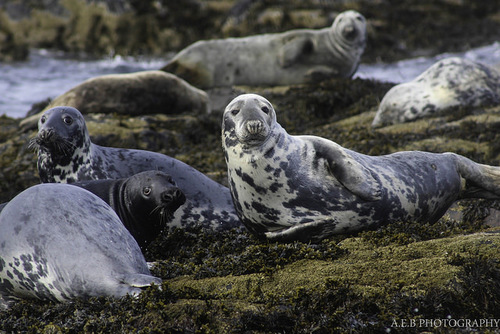
Grey Seal
Halichoerus grypus
The Grey Seal is the 'horse-head' of the Atlantic, a massive and soulful marine mammal known for its haunting songs and incredible diving prowess. Often found lounging on rocky skerries, these powerful hunters are a true icon of our wild coastlines.
Quick Identification
Size
Length: 1.6–3.3 m (5.2–10.8 ft); Weight: 100–350 kg (220–770 lbs)
Colors
Males are dark grey with lighter patches; females are silver-grey with darker spots and a lighter belly.
Key Features
- Distinctive long, sloping 'horse-like' snout profile
- Parallel, non-touching nostrils forming a 'W' shape
- Earless appearance with no external flaps
- Large, robust body with thick blubber
When You’ll See Them
Geographic range
Where Does the Grey Seal Live?
The Grey Seal is a native resident of the temperate and subarctic waters of the North Atlantic Ocean. It is found in two distinct populations: the western Atlantic group, which ranges from the shores of New Jersey and New York up through the Canadian Maritimes to Greenland, and the eastern Atlantic group, which thrives along the coasts of the United Kingdom, Ireland, Iceland, Norway, and the Baltic Sea. These seals are coastal specialists, rarely wandering far from the continental shelf, and they rely on secluded beaches and rocky skerries for pupping and molting.
Basemap © OpenStreetMap contributors
Behavior
Grey Seals are highly social animals when 'hauling out' on land, where they congregate in large groups to rest, molt, and breed. Despite their gregarious nature on the shore, they are largely solitary hunters at sea, capable of diving to depths of over 300 meters and staying submerged for up to 30 minutes. They are known for their haunting, melodic vocalizations—a mix of moans, growls, and hooting sounds—that can echo across rocky coastlines during the breeding season.
In their interactions with humans, Grey Seals are famously curious but maintain a cautious distance. They are often seen 'bottling' in the water, where they float vertically with only their heads above the surface, watching coastal observers. While they appear clumsy on land, using their front flippers to haul their massive weight over rocks, they are incredibly agile and powerful swimmers in the water, often traveling long distances between feeding grounds and resting sites.
EverydayEarth exclusive
Camera Tips
Capturing Grey Seals on a trail camera requires a strategic approach focused on 'haul-out' sites—the specific rocks or beach stretches where they come ashore to rest. Because these environments are high-salt and high-moisture, ensure your camera has a high IP rating (IP66 or better) and consider using a dedicated marine housing. Mount the camera low to the ground (about 12-18 inches) on a stable rock or a weighted tripod to capture their natural movement and that iconic 'horse-head' profile. Avoid using tree straps on soft sand; instead, look for driftwood or rocky crevices for secure anchoring.
Timing is everything when photographing seals. They are most likely to be on land during low tide, so cross-reference your camera's active hours with local tide charts. If your camera allows for time-lapse mode, set it to trigger every 5-10 minutes during the transition from high to low tide; this ensures you catch them as they emerge from the surf. For movement-triggered shots, set the PIR sensitivity to 'High,' as the seals can move slowly and their body temperature may be close to the ambient temperature of the wet sand.
Never use food or lures to attract seals; it is illegal in many jurisdictions and harmful to the animals. Instead, focus on camouflage. Grey Seals have excellent eyesight and may be spooked by a camera that stands out against the pale sand or dark rocks. Use a camera with a 'No-Glow' or 'Black LED' flash to prevent startling the seals during nighttime activity, as white light or red glows can cause an entire colony to flush back into the water, wasting their vital energy reserves.
Similar Species
Species that look similar or are commonly confused with Grey Seal.
Harbor Seal
Smaller with a snub-nosed, dog-like face and V-shaped nostrils that meet at the bottom.
Hooded Seal
Found in deeper Arctic waters; males have a unique inflatable nasal 'hood' and silvery fur with black spots.
Harp Seal
Distinctive black harp-shaped marking on the back of adults and a much more northern, ice-dependent range.
Frequently Asked Questions
Record Grey Seal at your habitat
Connect a camera to start building your own species record — AI identifies every visitor automatically.