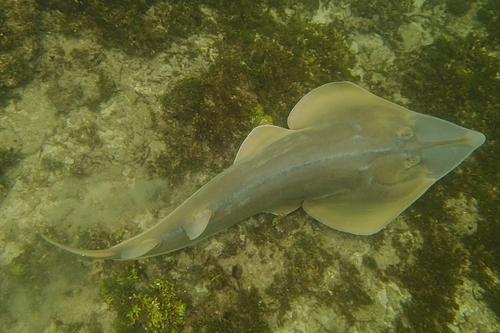
Halavi's Guitarfish
Glaucostegus halavi
A master of disguise that bridges the world between sharks and rays. Often called the 'Halavi Shark-Ray,' this critically endangered beauty is a rare treasure of the Indo-Pacific shallows.
Quick Identification
Size
Typically 80–120 cm (31–47 inches), with some reaching 150 cm (59 inches); weights average 10–18 kg (22–40 lbs).
Colors
Pale yellowish-brown to sandy-grey dorsal side with lighter margins; white or creamy-white ventral (underside).
Key Features
- Distinctive wedge-shaped snout with translucent edges
- Two large, shark-like dorsal fins located behind the pelvic fins
- Rows of small thorns or tubercles along the midline of the back
- Flattened, ray-like body with a thick, muscular tail
When You’ll See Them
Geographic range
Where Does the Halavi's Guitarfish Live?
Halavi's Guitarfish is native to the tropical and subtropical waters of the Indo-West Pacific, with its core populations found throughout the Red Sea and the Gulf of Oman. Its range extends eastward along the coasts of India and through the Persian Gulf. Interestingly, it has been recorded as a 'Lessepsian migrant' in the eastern Mediterranean, having traveled through the Suez Canal to settle in waters off the coast of Israel and Lebanon.
Basemap © OpenStreetMap contributors
Behavior
Halavi's Guitarfish is a benthic specialist, spending the vast majority of its life cruising along the seafloor or buried just beneath the sand. Despite their shark-like appearance, they are incredibly docile and shy, relying on their incredible camouflage to avoid detection by predators and humans alike. They are primarily solitary hunters that use a "pouncing" method to capture prey on the bottom.
These fish are most active during the crepuscular hours of dawn and dusk, when they move from deeper coastal waters into very shallow flats to feed. While they are capable of fast bursts of speed when threatened, they usually glide slowly over the substrate. In areas with human activity, they tend to keep their distance, though they are frequently found in shallow estuaries and near boat docks where food sources are abundant.
EverydayEarth exclusive
Camera Tips
Capturing Halavi's Guitarfish requires an underwater camera setup, such as an AI-powered action camera in a waterproof housing or a dedicated Baited Remote Underwater Video (BRUV) system. For those with coastal property or access to shallow bays, place your camera at a depth of 1 to 3 meters during the incoming tide. Position the lens horizontally, roughly 15-20 centimeters off the sandy floor, facing a clear patch of substrate near a sea-grass edge or reef structure.
To attract this elusive species to your camera's field of view, use a perforated bait container filled with crushed oily fish like sardines or mackerel. The scent trail is highly effective at drawing them out from their buried positions. Because they are masters of camouflage, use high-resolution settings (4K) to help the AI distinguish their sandy outlines against the sea floor.
Lighting is crucial for identification. If filming at dawn or dusk (their peak activity times), ensure you have a wide-angle underwater video light set to a low intensity to avoid scaring them off. For the best results, leave the camera stationary for at least two hours; these fish are cautious and may take time to approach a new object in their environment. Check your footage for the tell-tale 'vibration' in the sand that indicates a guitarfish is unburying itself.
Similar Species
Species that look similar or are commonly confused with Halavi's Guitarfish.
Bowmouth Guitarfish
Much larger with a distinctively wide, rounded snout and high dorsal fins.
Common Guitarfish
Lacks the translucent snout edges and is typically found further west in the Mediterranean and Atlantic.
Giant Guitarfish
Grows significantly larger (up to 3 meters) and has black spots on its dorsal surface.
Frequently Asked Questions
Record Halavi's Guitarfish at your habitat
Connect a camera to start building your own species record — AI identifies every visitor automatically.