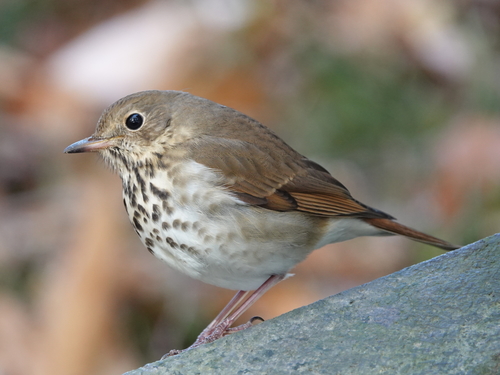
Hermit Thrush
Catharus guttatus
A champion of the forest floor, the Hermit Thrush is celebrated for its hauntingly beautiful song and resilient spirit. It is the only thrush of its kind to brave the North American winter, often appearing as a subtle, tail-flicking visitor in quiet winter gardens.
Quick Identification
Size
Length: 15–18 cm (5.9–7.1 in); Wingspan: 25–30 cm (9.8–11.8 in); Weight: 18–37 g (0.6–1.3 oz)
Colors
Brownish upperparts with a contrasting reddish-brown tail; white underparts with distinct dark spots on the throat and breast; dull white eye-ring.
Key Features
- Distinctive reddish tail that contrasts with a browner back
- Frequent habit of slowly raising and lowering its tail
- Bold, smudged dark spots on a pale breast
- Complete, thin white eye-ring
When You’ll See Them
Geographic range
Where Does the Hermit Thrush Live?
The Hermit Thrush is a native North American traveler with a range stretching from the boreal forests of Alaska and Canada down through the mountainous western and northeastern United States. During the winter months, these hardy birds migrate to the southern United States and continue as far south as Central Mexico and Guatemala. Notably, it is the most cold-tolerant of the North American thrushes, often remaining in more northern latitudes throughout the winter while its relatives have migrated to the tropics.
Basemap © OpenStreetMap contributors
Behavior
The Hermit Thrush is a bird of the forest understory, known for its somewhat shy and solitary nature. It is often first detected by its ethereal, flute-like song, which many consider one of the most beautiful in North America. Unlike many other songbirds, it spends a significant amount of its time on the ground, hopping through leaf litter in search of food. A key behavioral giveaway is its tendency to flick its wings and then slowly raise and lower its tail, a nervous habit that helps birdwatchers identify it from a distance.
While they are primarily forest dwellers during the breeding season, Hermit Thrushes become more adaptable during the winter. They are the only member of their genus to winter extensively in North America, often appearing in suburban backyards where there is enough cover and fruit. They generally avoid large flocks, preferring to forage alone or in small, loose groups near protective thickets. Their interaction with humans is usually passive; they are not aggressive but will quickly retreat to cover if they feel exposed.
EverydayEarth exclusive
Camera Tips
To capture a Hermit Thrush on your backyard camera, you need to think low. These birds are specialized ground-foragers, so mounting your camera just 6 to 12 inches off the ground is the most effective strategy. Aim the lens at a flat area covered in leaf litter, preferably near a brush pile or dense evergreen shrubbery where the bird feels safe to emerge and forage. Because they hop and pause frequently, a standard trigger speed is usually sufficient, but enabling a burst mode will help you capture their characteristic tail-flicking motion.
Water is the single best lure for a Hermit Thrush. Unlike many birds that prefer elevated baths, this species is much more likely to visit a ground-level water feature. A shallow stone basin with a small solar dripper or a recirculating pump creates the sound of moving water that they find irresistible. Position your camera 3 to 5 feet away from the water's edge, ensuring the focus is set for close-up action. This is particularly effective during the fall and spring migration windows when birds are looking to refuel and hydrate.
During the winter, you can attract them with specific food offerings. While they rarely visit hanging seed feeders, they will readily investigate a 'ground station' stocked with high-fat items. Offer suet crumbles, dried mealworms, or finely chopped raisins on a flat rock or low platform. Because they are early risers, ensure your camera's PIR (passive infrared) sensor sensitivity is set to high; this ensures you catch them in the soft, low-light conditions of dawn when they are most active before other more dominant backyard birds arrive.
Similar Species
Species that look similar or are commonly confused with Hermit Thrush.
Wood Thrush
Larger with bolder, more defined round spots on the breast and a reddish head rather than a reddish tail.
Swainson's Thrush
Lacks the reddish tail and has more prominent buffy 'spectacles' around the eyes.
Veery
Uniformly cinnamon-brown all over with much lighter, less distinct spotting on the breast.
Frequently Asked Questions
Record Hermit Thrush at your habitat
Connect a camera to start building your own species record — AI identifies every visitor automatically.