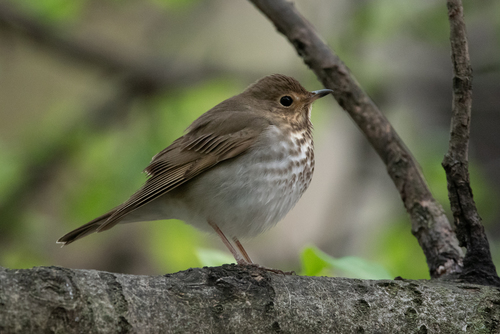
Swainson's Thrush
Catharus ustulatus
The ghost of the forest understory, the Swainson’s Thrush is best known for its haunting, upward-spiraling song. With its signature golden 'spectacles' and secretive nature, capturing one on camera is a rewarding challenge for any nature lover.
Quick Identification
Size
Length: 6.3–7.5 in (16–19 cm); Wingspan: 11.4–12.2 in (29–31 cm); Weight: 0.8–1.6 oz (23–45 g)
Colors
Uniform olive-brown to russet upperparts; buffy throat and breast with dark spotting; distinct buffy-yellow 'spectacles' around the eyes.
Key Features
- Distinctive buffy eye-rings or 'spectacles'
- Spotted breast with a warm, yellowish wash
- Uniformly colored back and tail without contrasting red
- Nervous, frequent wing-flicking behavior
When You’ll See Them
Behavior
Swainson's Thrushes are the shy, melodic spirits of the forest undergrowth. Often heard long before they are seen, they spend much of their time hopping through damp leaf litter or navigating low branches in search of insects. They possess a characteristic 'wing-flicking' habit when perched—a quick, nervous fluttering of the wings that helps distinguish them from other similar thrushes. Unlike their bolder relative, the American Robin, this species avoids open lawns, preferring the safety of dense foliage.
During the breeding season, they are world-renowned for their ethereal, flute-like song that spirals upward in pitch. While they are solitary during the summer months, they are impressive long-distance migrants, traveling thousands of miles at night between North American forests and South American wintering grounds. In a backyard setting, they are most likely to appear as quiet, transient visitors during the spring and fall migration peaks.
EverydayEarth exclusive
Camera Tips
To capture the elusive Swainson's Thrush, you need to think low and dark. These birds are ground-dwellers that thrive in the shadows. Position your camera just 6 to 12 inches off the ground, aiming it at a patch of natural leaf litter or the edge of a dense thicket. Because they are wary of open spaces, avoid placing your camera in the middle of a sunlit lawn; instead, tuck it into the 'edge' zone where garden meets wild growth.
Water is the absolute best lure for this species. While they rarely visit traditional seed feeders, they are highly attracted to the sound of moving water. A shallow, ground-level birdbath with a small dripper or solar fountain is a magnet for thrushes. Place your camera 3-5 feet away from the water source and ensure the area is well-shaded. They are most likely to visit for a bath in the cool of the early morning or the late afternoon when light levels are lower.
Since these birds move with quick, hopping motions and frequent wing-flicks, shutter speed and trigger sensitivity are critical. Set your AI-powered camera to its highest sensitivity and use a multi-shot burst mode (3-5 photos per trigger). This ensures you catch them mid-hop or with their head turned, allowing you to clearly see the buffy 'spectacles' around their eyes—the key feature for identification. If your camera supports video, short 10-second clips are excellent for capturing their unique foraging style.
If you are looking to attract them during the fall, consider planting native berry-producing shrubs like serviceberry or dogwood within the camera's field of view. During migration, they will spend more time in one spot if there is a reliable food source, giving your camera more opportunities to wake up and record. Because they are nocturnal migrants, you might even catch them arriving in your yard just as the sun begins to rise.
Similar Species
Species that look similar or are commonly confused with Swainson's Thrush.
Hermit Thrush
The Hermit Thrush has a noticeably reddish tail that contrasts with its brown back, and it lacks the warm buffy spectacles of the Swainson's.
Wood Thrush
The Wood Thrush is larger with much bolder, distinct black spots on a bright white breast and a more reddish-brown head.
Veery
The Veery has much lighter, blurrier spotting on the chest and a more uniform cinnamon-brown color across its entire upper body.
Frequently Asked Questions
Record Swainson's Thrush at your habitat
Connect a camera to start building your own species record — AI identifies every visitor automatically.