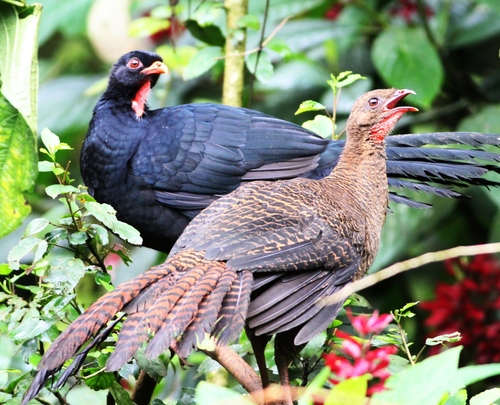
Highland Guan
Penelopina nigra
A rare and striking resident of Central America's misty cloud forests, the Highland Guan is known for its glossy black plumage and unique mechanical wing-calls. Often heard but rarely seen, this elusive bird is a true prize for any backyard observer in the mountains.
Quick Identification
Size
59-65 cm (23-26 in) in length; weight approximately 840-1000g (1.8-2.2 lbs)
Colors
Sexual dimorphism: Males are glossy black with a blue-green sheen and a red throat wattle; females are reddish-brown with heavy black barring.
Key Features
- Distinctive red bill and legs in both sexes
- Males have a bright red dewlap or throat wattle
- Long, broad tail used for balance in the canopy
- Deeply barred rufous plumage in females
When You’ll See Them
Geographic range
Where Does the Highland Guan Live?
Native to the rugged highlands of Central America, the Highland Guan occupies a fragmented range stretching from the southern Mexican state of Chiapas through the mountains of Guatemala, El Salvador, and Honduras. Its distribution reaches its southern limit in the central highlands of Nicaragua, where it is found only in high-altitude forest remnants.
Basemap © OpenStreetMap contributors
Behavior
The Highland Guan is a shy and largely arboreal bird, spending the majority of its life in the canopy of undisturbed cloud forests. They are most famous for the male's unique courtship display, where he performs a gliding flight between trees while producing a loud, mechanical rattling sound with his wings, often compared to the sound of a falling tree or crashing wood.
Socially, they are usually found in pairs or small family groups. While they are wary of human presence and will quickly retreat into dense foliage if disturbed, they can be quite vocal in the early morning. Their repertoire includes various whistling calls and chirps used to maintain contact with others in the thick mountain mist.
EverydayEarth exclusive
Camera Tips
Capturing the Highland Guan on camera requires moving beyond the traditional ground-level trail cam setup. These birds are almost exclusively arboreal, so you should focus on placing your AI-powered camera 6 to 12 feet up a tree. Look for 'corridors' of branches that connect large fruiting trees, such as wild avocados or laurels, as the guans frequently use these high-altitude highways to move through the forest.
If you live in a highland area near their habitat, a high-mounted water feature can be an incredible draw. A dripping water basin or an elevated birdbath placed near the edge of a forest canopy can lure them into clear view. Position your camera to face north or south to avoid the harsh backlighting of the mountain sun, which can wash out the glossy black details of the male's feathers.
Set your camera to video mode or high-speed burst. Highland Guans move with a deceptive agility among branches; a single photo might only capture a tail. Short 20-second video clips are ideal for capturing their social interactions and the male's occasional 'wing-rattling' sounds. Since cloud forests are notoriously damp, always use fresh desiccant packs inside your camera housing to prevent the lens from fogging during the misty mornings when these birds are most active.
Similar Species
Species that look similar or are commonly confused with Highland Guan.
Frequently Asked Questions
Record Highland Guan at your habitat
Connect a camera to start building your own species record — AI identifies every visitor automatically.