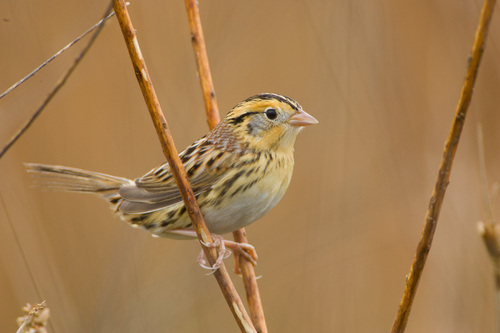
LeConte's Sparrow
Ammospiza leconteii
The LeConte's Sparrow is the 'grass-mouse' of the bird world, a secretive master of the prairie with stunning buff-orange plumage hidden within the densest meadows.
Quick Identification
Size
Length: 11-13 cm (4.3-5.1 in); Wingspan: 18 cm (7.1 in); Weight: 12-17 g (0.4-0.6 oz)
Colors
Bright buff-orange face and breast; gray ear patches; white crown stripe; dark streaking on a brown and black back; white belly.
Key Features
- Bright buff-orange supercilium (eyebrow)
- Finely streaked flanks and gray nape
- Very short, pointed tail
- Flat-headed profile with a small, dark bill
When You’ll See Them
Geographic range
Where Does the LeConte's Sparrow Live?
Native to North America, the LeConte’s Sparrow spends its breeding season across the damp meadows and grasslands of central and western Canada, reaching into the northern Great Plains of the United States. As winter approaches, these secretive birds migrate toward the southeastern United States, establishing a wintering range that spans from Texas across the Gulf Coast and up into the Atlantic coastal plain. They are highly specialized birds of the interior grasslands, rarely straying far from their preferred corridor of mid-continental flyways.
Basemap © OpenStreetMap contributors
Behavior
The LeConte's Sparrow is famously one of the most elusive birds in North America, often described as 'mouse-like' due to its preference for running through dense grass rather than taking flight. When startled, it typically flies a short distance with a weak, fluttering motion before dropping back into the vegetation and instantly vanishing. Because of this secretive nature, they are rarely seen in the open, making them a prize find for backyard observers in the right habitat.
During the breeding season, males sing a thin, high-pitched, insect-like buzz that can be easily missed by the untrained ear. They are generally solitary or found in pairs, though they may form loose, quiet groups during migration or on their wintering grounds in the southern United States. Their interactions with humans are virtually non-existent, as they rely on their camouflage and terrestrial habits to remain undetected.
EverydayEarth exclusive
Camera Tips
Capturing a LeConte’s Sparrow on a trail camera requires a specialized ground-level setup because these birds rarely venture into the canopy. Position your camera extremely low—about 6 to 10 inches off the ground—pointing toward a natural opening or 'trail' within tall, thick grass. Because they prefer walking to flying, they often use consistent paths through the thatch which can be identified by looking for slightly parted grass at the base of clumps.
Since this species moves with a quick, jerky motion, a camera with a lightning-fast trigger speed (0.2 seconds or less) is essential. Set your camera to 'Burst Mode' to take 3-5 photos per trigger. This is crucial because the first photo often catches only the tail as the sparrow scurries by, while the subsequent shots are more likely to capture that signature buff-orange face. High sensitivity settings are recommended, but try to clear away any loose grass blades directly in front of the lens to prevent false triggers from the wind.
While they are unlikely to visit a standard hanging feeder, you can lure them into the camera's view by creating a ground-level 'microsite.' Scatter a mix of high-quality millet and finely cracked corn in a small 2-foot cleared circle. If you have a water feature, a ground-level birdbath with a very slow dripper is highly effective, as the sound of splashing water is one of the few things that will coax a LeConte's Sparrow out of the deep cover and into the clear view of your lens.
Similar Species
Species that look similar or are commonly confused with LeConte's Sparrow.
Nelson's Sparrow
Nelson's has a darker face, blurrier breast streaks, and lacks the bright white stripe through the center of the crown.
Henslow's Sparrow
Henslow's has a distinctive olive-green wash on the head and nape, compared to the orange and gray of the LeConte's.
Grasshopper Sparrow
Grasshopper Sparrows have unstreaked breasts as adults and a much larger, heavier bill.
Frequently Asked Questions
Record LeConte's Sparrow at your habitat
Connect a camera to start building your own species record — AI identifies every visitor automatically.