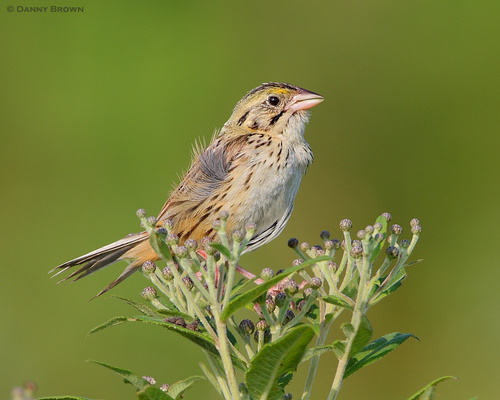
Henslow's Sparrow
Centronyx henslowii
A secretive treasure of the American prairie, Henslow's Sparrow is a master of camouflage known for its olive-green head and mouse-like behavior in tall grass.
Quick Identification
Size
Length: 11-13 cm (4.3-5.1 in); Wingspan: 16-19 cm (6.3-7.5 in); Weight: 11-15 g (0.4-0.5 oz)
Colors
Olive-green head and nape, reddish-brown wings, white belly, and buffy breast with fine black streaks; sexes look identical
Key Features
- Distinct olive-green wash on the head and neck
- Short, notched tail and a relatively large, flat head
- Reddish-brown (rufous) coloration on the wings
- Fine black streaking across the breast and along the flanks
When You’ll See Them
Geographic range
Where Does the Henslow's Sparrow Live?
This secretive sparrow is native to North America, primarily breeding across the Midwestern and Northeastern United States with small populations reaching into Southern Ontario, Canada. During the winter, they migrate south to the coastal pine savannas and grassy swales of the Southeastern United States, ranging from North Carolina through Florida and west into eastern Texas. Because they are habitat specialists, their presence is often localized to specific protected prairies and reclaimed grasslands.
Basemap © OpenStreetMap contributors
Behavior
Henslow's Sparrows are notoriously secretive birds, often described as behaving more like mice than songbirds. Instead of taking flight when disturbed, they prefer to run through thick thatch and tall grasses. They are most easily detected during the breeding season when males perch atop sturdy weed stalks to deliver their remarkably short, metallic-sounding song—a simple 'tsick-le' that can be easily missed by the untrained ear.
These sparrows are highly sensitive to habitat changes and require large, contiguous tracts of grassland with a thick layer of ground litter (standing dead vegetation from previous years). They are generally non-aggressive and forage quietly on the ground, making them a challenge for backyard observers unless they live adjacent to managed conservation lands or fallow fields. Their social structure is loosely colonial, meaning if you find one breeding pair, there are likely several more in the immediate vicinity.
EverydayEarth exclusive
Camera Tips
Capturing a Henslow's Sparrow on camera requires a strategic approach because they rarely visit traditional bird feeders. The best strategy is to place your AI-powered camera on a low tripod or a ground stake near the edges of tallgrass fields or meadows that haven't been mowed or burned for at least two years. Look for 'song perches'—isolated, sturdy stalks of mullein, dock, or dead grass that stand slightly above the surrounding vegetation. Aim your camera at these perches during the breeding season (May-July).
Since these birds spend most of their time on the ground under a canopy of grass, set your camera's trigger sensitivity to high. If your camera allows for video, use a high frame rate; the Henslow's Sparrow's song is accompanied by a very quick, characteristic head-flick that is fascinating to see in slow motion. Focus the lens about 12-18 inches off the ground to catch them as they emerge from the thatch to sing.
Because they are sensitive to disturbance, avoid frequent visits to the camera site. Use a cellular-enabled camera if possible to monitor the feed remotely. Avoid using heavy baits which might attract predators like raccoons to the nesting area; instead, rely on the bird's natural preference for specific singing perches. The best time for activity is just after sunrise on calm, humid mornings when their short songs carry furthest.
Similar Species
Species that look similar or are commonly confused with Henslow's Sparrow.
Grasshopper Sparrow
Lacks the olive-green head and has a much cleaner, unstreaked breast compared to the Henslow's.
Savannah Sparrow
Has a yellow patch near the eye (lores) and lacks the distinctive reddish-brown wing color of the Henslow's.
LeConte's Sparrow
Smaller with a much more orange-buffy face and a white stripe down the center of the crown.
Frequently Asked Questions
Record Henslow's Sparrow at your habitat
Connect a camera to start building your own species record — AI identifies every visitor automatically.