Lincoln's Sparrow
Melospiza lincolnii
Meet the Lincoln's Sparrow, the shy 'mouse' of the bird world. This secretive traveler is prized by birders for its sweet, wren-like song and its delicately streaked, buff-colored plumage.
Quick Identification
Size
Length: 5.1-5.9 in (13-15 cm); Wingspan: 7.5-8.7 in (19-22 cm); Weight: 0.4-0.8 oz (12-22 g)
Colors
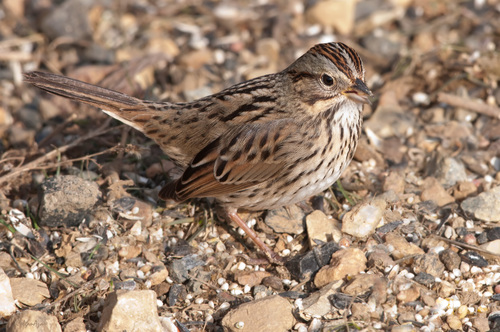
Rich buffy-colored band across the breast and flanks with fine black streaks; grayish face with brown eyestripes; white belly and olive-brown back.
Key Features
- Distinctive buff-colored chest band with fine black streaks
- Grayish face with a subtle brown crown stripe and eyeline
- Short, rounded tail and a relatively small, sharp bill
- Mouse-like behavior, staying low in dense ground cover
When You’ll See Them
Geographic range
Where Does the Lincoln's Sparrow Live?
Native to the North American continent, the Lincoln's Sparrow follows a broad migratory path that spans from the Arctic to the tropics. Its breeding grounds are primarily located in the boreal forests of Canada and Alaska, as well as the high-elevation meadows of the Rocky Mountains and Sierra Nevada. As winter approaches, these birds journey south to inhabit the southern United States, Mexico, and northern Central America, seeking out damp, brushy areas where they can spend the season in relative seclusion.
Basemap © OpenStreetMap contributors
Behavior
Lincoln's Sparrows are the introverts of the sparrow family. Unlike the bold Song Sparrow, this species is famously secretive, preferring to skulk through dense undergrowth and thickets where it can remain nearly invisible to the casual observer. They move with a quiet, mouse-like efficiency, hopping through leaf litter and tangled branches rather than flying in the open. They are solitary by nature, rarely joining large mixed-species flocks except during the peak of migration.
Despite their shy personality, they are celebrated for their remarkably beautiful song—a rich, gurgling series of trills and whistles that is surprisingly loud for such a small bird. This song is often the only way birders can locate them in their preferred boggy or brushy habitats. In suburban settings, they are most likely to be seen during spring and fall migration, usually darting quickly between shrubs or visiting ground-level water features.
EverydayEarth exclusive
Camera Tips
To capture a Lincoln's Sparrow on an AI camera, you must think like a ground-dweller. Because they rarely venture into the open canopy, place your camera very low—ideally between 6 and 10 inches off the ground. Aim the lens toward the 'edge' of a brush pile, a dense hedge, or a thicket of tall grass. They are most comfortable moving along these transition zones where they can quickly retreat into cover if they feel threatened.
Water is your best friend when trying to attract this elusive bird. A shallow, ground-level birdbath with a slow-dripping feature or a small recirculating fountain is far more effective than a hanging feeder. Position your camera to face the water source from a distance of 3-5 feet to ensure a clear focus. Since Lincoln's Sparrows are 'skulkers,' they will often approach the water by hopping through the grass rather than flying directly to it, so keep the area around the water source natural and messy with leaf litter.
If you are using food as a lure, skip the elevated feeders. Instead, scatter a high-quality mix of white proso millet and finely cracked corn directly on the ground near the camera. During the winter or migration, they may also be attracted to mealworms. Set your camera's motion sensitivity to high; because these birds are small and move with quick, twitchy gestures, a low-sensitivity setting might miss their brief appearances before they dart back into the shadows.
The first two hours of daylight are the prime time for Lincoln's Sparrow activity. Ensure your camera is positioned to avoid direct sunrise glare, which can wash out the fine details of their streaked plumage. If your camera has a video mode, use it—their mouse-like movements and occasional tail-flicks are much easier to identify in motion than in a single still photo.
Similar Species
Species that look similar or are commonly confused with Lincoln's Sparrow.
Song Sparrow
Larger with thicker, blurrier breast streaks that usually form a central 'blotch' rather than a fine buffy band.
Swamp Sparrow
Features a deeper rusty-red wing and crown, with a gray chest that lacks the fine streaking of the Lincoln's Sparrow.
Savannah Sparrow
Commonly has a yellow patch near the eye and prefers open grasslands rather than the brushy thickets favored by Lincoln's.
Frequently Asked Questions
Record Lincoln's Sparrow at your habitat
Connect a camera to start building your own species record — AI identifies every visitor automatically.