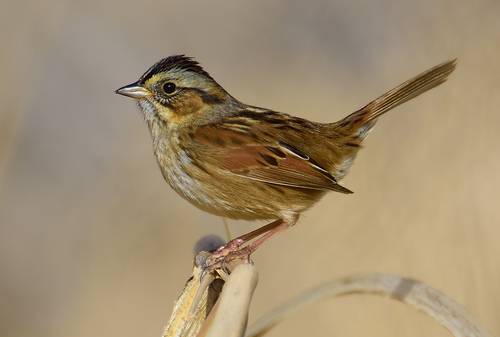
Swamp Sparrow
Melospiza georgiana
A secretive master of the marsh, the Swamp Sparrow is a beauty of the wetlands, distinguished by its elegant rusty plumage and clear gray breast. Often heard trilling from the reeds before it is seen, this bird is a prize for any backyard wildlife observer with a damp corner or pond to call their own.
Quick Identification
Size
Length: 12-14 cm (4.7-5.5 in); Wingspan: 18-19 cm (7.1-7.5 in); Weight: 11-24 g (0.4-0.8 oz)
Colors
Rich rusty-brown wings and back; clear gray breast and neck; white throat; reddish-brown cap in breeding adults; dark eye line.
Key Features
- Solid gray breast without heavy streaking
- Bright rusty-brown wings and tail
- Distinct white throat patch
- Reddish cap (breeding) or striped crown (winter)
- Longer legs than most similar sparrows
When You’ll See Them
Behavior
The Swamp Sparrow is a reclusive and somewhat secretive member of the sparrow family, often described as 'mouse-like' due to its habit of scurrying through dense wetland vegetation. Unlike the more social Song Sparrow, this species prefers to stay tucked away in the shadows of reeds, cattails, and brushy thickets. When they do emerge, they are most often seen hopping along muddy edges or at the very base of shrubs near water.
These birds are known for their distinct foraging style, frequently wading in shallow water or reaching into the mud to find aquatic invertebrates. While they are generally solitary during the breeding season, they may join loose 'sparrow parties' in the winter, mixing with White-throated or Song Sparrows in damp, overgrown fields. Despite their shy nature, they are vocal during the spring, with males delivering a loud, rhythmic, and liquid trill from a low perch within the marsh.
EverydayEarth exclusive
Camera Tips
Capturing a Swamp Sparrow on camera requires a bit more finesse than your average backyard bird because of their preference for wet, dense cover. The most successful camera placements are at ground level, ideally 6 to 12 inches off the floor, positioned at the edge of a pond, creek, or a marshy patch of your yard. These birds rarely fly high, so an upward-angled camera near a muddy bank is your best bet for a clear shot of their distinct gray breast and rusty wings.
To attract them to your camera's field of view, utilize their love for water. A shallow ground-level birdbath or even a simple saucer of water placed near thick brush can be a magnet. Adding a small water dripper or bubbler is particularly effective; the sound of moving water will pull them out of the thicket more reliably than seed alone. If you are using food as a lure, spread white proso millet or sunflower hearts directly on the ground or on a low platform feeder near the water's edge, as they are hesitant to use hanging feeders.
Because Swamp Sparrows are fast and twitchy, set your AI camera to a high-sensitivity motion trigger and use a short 'burst mode' or video setting. A 10-second video clip is often better than a single photo, as it captures their unique hopping and tail-flicking behaviors. For the best image quality, aim for early morning light when the birds are most active foraging. If you live in a colder climate, late autumn is a fantastic time for camera captures, as the birds become slightly more adventurous while searching for high-energy seeds before the ground freezes.
Similar Species
Species that look similar or are commonly confused with Swamp Sparrow.
Song Sparrow
The Song Sparrow has heavy brown streaking on its breast and a central dark spot, whereas the Swamp Sparrow has a clear gray breast.
Lincoln's Sparrow
Lincoln's Sparrows have fine black streaks on a buff-colored (tan) breast band, while the Swamp Sparrow's breast is unstreaked gray.
Chipping Sparrow
Chipping Sparrows are smaller with a distinct black line through the eye and a white eyebrow, lacking the Swamp Sparrow's rich rusty wing color.
Frequently Asked Questions
Record Swamp Sparrow at your habitat
Connect a camera to start building your own species record — AI identifies every visitor automatically.