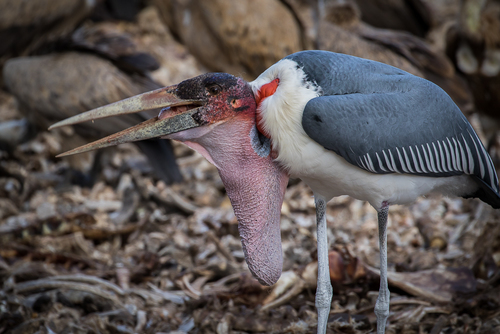
Marabou Stork
Leptoptilos crumenifer
With its massive wingspan and prehistoric profile, the Marabou Stork is one of Africa's most imposing and adaptable birds. Known as the 'Undertaker Bird' for its cloak-like wings, it is a master of the savanna and a frequent visitor to urban landscapes.
Quick Identification
Size
Length: 120–150 cm (47–59 in); Wingspan: 2.2–2.9 m (7.2–9.5 ft); Weight: 4.5–9 kg (10–20 lbs)
Colors
Slate-grey back and wings; white underparts; pinkish-red bare head and neck; horn-colored bill; white legs
Key Features
- Massive wedge-shaped bill
- Bare pinkish head and neck with a pendulous throat sac
- Slate-grey 'cloak' of wings over white underparts
- Legs often coated in white-colored uric acid
When You’ll See Them
Sightings on EverydayEarth
Jul 30, 2026
A bustling morning scene at a waterhole features multiple hippos lounging in the water, with one large individual walking along the right bank into the river. On the far grassy bank, a common warthog trots from right to left. Several water birds are present, including an African spoonbill on a log, and a black-headed heron and marabou stork standing on foreground rocks.
Jul 29, 2026
A group of hippopotamuses are resting in and around a river channel. In the foreground, a Marabou Stork is perched on a large fallen log. A Grey Heron stands on a rock in the middle of the stream, while another smaller reptile, possibly a crocodile, basks on a nearby stone. The scene is quiet with very little movement from the animals.
Jul 19, 2026
A group of hippopotamuses is resting in the shallow water of a woodland pond, with only their broad backs and small ears visible above the surface. A Marabou Stork stands motionless on a prominent rock in the middle of the water, and an Egyptian Goose is perched on a nearby fallen log. The surrounding landscape is characterized by dry grasses and sparse trees under a clear, sunny sky.
Jun 28, 2026
A group of hippopotamuses is resting in a waterhole, with several individuals surfacing to breathe. A cluster of Egyptian Geese is perched on a partially submerged log in the middle of the pool, while a Marabou Stork stands motionless on a nearby rock formation. The surrounding woodland is quiet under the bright morning sun.
Apr 12, 2026
A group of hippopotamuses is resting submerged in a muddy watering hole. Several Egyptian Geese swim nearby, while Marabou Storks stand on the far bank and in the shallow water. The scene is quiet, with only slight movements from the hippos and birds under the bright midday sun.
Apr 1, 2026
Several hippopotamuses are resting in a murky watering hole, mostly submerged with only their heads and backs breaking the surface. A Marabou Stork stands prominently on a rock in the center of the pond, remaining relatively still, while several smaller white birds forage nearby along the rocks and muddy banks.
Geographic range
Where Does the Marabou Stork Live?
The Marabou Stork is native to the African continent, specifically the regions south of the Sahara Desert. Its core range includes East African nations such as Kenya, Ethiopia, and Tanzania, but it is also frequently spotted across Southern Africa in countries like Botswana and South Africa. While there are no established introduced populations outside of Africa, this species has expanded its local footprint significantly by moving into suburban landscapes and landfill sites where food is abundant.
Basemap © OpenStreetMap contributors
Behavior
These storks are remarkably patient scavengers, often spending hours standing perfectly still or soaring on warm air thermals to scout for carcasses. While they have a reputation for being quiet, they communicate through bill-clattering and various guttural croaks. They are increasingly bold around human settlements, showing a high level of intelligence and adaptability when it comes to finding easy meals in urban environments.
EverydayEarth exclusive
Camera Tips
When setting up a camera for the Marabou Stork, height and angle are your most important considerations. Because these birds can stand up to five feet tall, you should mount your camera at least 3 to 4 feet off the ground. A low-angle shot might only capture their legs, which often appear white due to a cooling behavior called urohydrosis. Aim your camera slightly upward if the birds are expected to be close, or ensure a wide-angle lens is used to capture their massive 9-foot wingspan if they take flight or engage in wing-spreading displays.
Placement should focus on open areas with high visibility. In wilder settings, look for drying pools of water during the dry season or the outskirts of a carcass where they wait for vultures to finish. In more suburban or semi-rural African settings, placing a camera near a compost pile or a regular disposal area is highly effective. They are attracted to any source of protein, so if you are using lures, fish scraps or meat trimmings are the most effective baits. Always ensure your camera is housed in a protective, rugged case, as Marabous are curious and their heavy bills can easily damage exposed equipment.
Since Marabous are primarily active during the day, focus your settings on daylight capture. High-speed video mode is particularly rewarding with this species; it allows you to see the rhythmic inflation of their pink throat sac and the clattering of their bills during social interactions. If your camera has a time-lapse feature, use it near known roosting trees—typically tall, flat-topped acacias—to capture the morning departure and evening arrival of the colony. These birds are slow movers on the ground, so a standard trigger speed of 0.5 seconds is usually more than enough to catch them in action.
Similar Species
Species that look similar or are commonly confused with Marabou Stork.
Greater Adjutant
Found in Asia rather than Africa, it lacks the dense white downy feathers on the neck that Marabous possess.
Shoebill
While also a large African bird, the Shoebill has a distinct blue-grey plumage and a much wider, shoe-shaped bill.
Yellow-billed Stork
Much smaller with a bright yellow bill and white plumage, lacking the bare pink head of the Marabou.
Frequently Asked Questions
Record Marabou Stork at your habitat
Connect a camera to start building your own species record — AI identifies every visitor automatically.