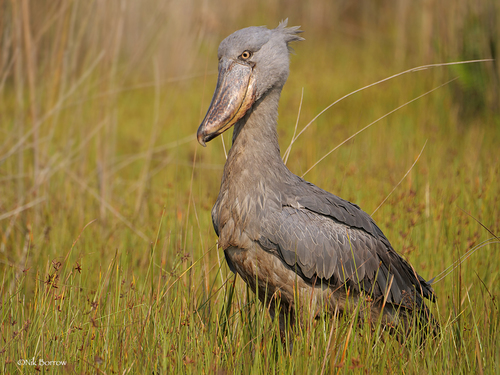
Shoebill
Balaeniceps rex
Step back in time with the Shoebill, a prehistoric-looking giant of the African wetlands. Known for its massive wooden-clog bill and steady, golden gaze, this bird is the ultimate prize for wildlife observers.
Quick Identification
Size
Height: 110–140 cm (43–55 in); Wingspan: 230–260 cm (7.5–8.5 ft); Weight: 4–7 kg (8.8–15.4 lb)
Colors
Primary plumage is a uniform slate-grey. The wings show darker grey flight feathers, while the massive bill is a mottled yellowish-tan with dark grey spots. Eyes range from pale yellow to light blue.
Key Features
- Massive shoe-shaped bill with a sharp hooked tip
- Short, shaggy feather crest on the back of the head
- Long, dark legs with exceptionally large feet for walking on vegetation
- Pale, piercing eyes and a broad, prehistoric facial structure
When You’ll See Them
Behavior
The Shoebill is a solitary and remarkably patient predator, often referred to as 'statue-like' for its ability to stand motionless in deep swamps for hours. They are ambush hunters that wait for poorly oxygenated fish to surface. When they strike, they perform a 'collapse'—a sudden, powerful lunge where the bird falls forward with its bill open, using its weight to overwhelm prey in the thick vegetation.
Socially, Shoebills are quite shy and maintain large territories. They are known for a unique communication method called 'bill-clattering,' where they snap their mandibles together to produce a loud, hollow sound reminiscent of a machine gun. While they generally avoid human contact, they have been known to allow close approach by researchers and quiet observers, provided their nesting sites are not disturbed.
EverydayEarth exclusive
Camera Tips
Capturing a Shoebill on camera requires a specialized approach due to their 'statue-like' behavior. Because they can stand perfectly still for up to 30 minutes at a time, standard PIR (Passive Infrared) sensors on trail cameras may fail to re-trigger. To combat this, we recommend using a 'Time-Lapse' mode alongside the motion trigger, set to take a photo every 5-10 minutes. This ensures you don't miss long hunting sessions where the bird is physically present but not moving enough to trip the sensor.
Position your camera approximately 2 to 3 feet above the water level, ideally mounted on a sturdy pole or a thick papyrus clump near an open 'pocket' of water. These birds frequent 'lungs'—small clearings in the swamp where lungfish come up for air. Aim the camera horizontally or slightly downward to capture the full scale of their 5-foot height. Avoid placing cameras too close to the ground in areas prone to sudden water level rises, as African wetlands can flood rapidly after heavy rains.
Since Shoebills are most active during the cooler morning and evening hours, ensure your camera has high-quality low-light sensors. A 'Burst Mode' of 3-5 photos per trigger is essential; you want to capture the exact moment of the 'collapse' strike, which happens in a split second. If your camera supports video, set it to record for at least 30 seconds per trigger to capture the fascinating bill-clattering behavior or the slow, deliberate 'slow-motion' walking style they use when repositioning.
Lastly, consider the environment’s high humidity. Use desiccants inside your camera housing to prevent lens fogging, which is common in tropical swamps at dawn. While you can't easily 'bait' a Shoebill, placing your camera near a known nesting site or a popular fishing hole identified by 'whitewash' (bird droppings) on the vegetation will significantly increase your success rate. Always ensure the camera is well-camouflaged with local reeds to prevent curious hippos or other wildlife from interfering with your gear.
Similar Species
Species that look similar or are commonly confused with Shoebill.
Goliath Heron
Much thinner, pointed bill and a reddish-brown neck compared to the Shoebill's grey plumage and bulbous bill.
Marabou Stork
Features a white underbelly, a pinkish neck sac, and a straight, wedge-shaped bill rather than a curved, shoe-like one.
Great White Pelican
Shares the Pelecaniformes order but is white with a large throat pouch and shorter legs.
Frequently Asked Questions
Record Shoebill at your habitat
Connect a camera to start building your own species record — AI identifies every visitor automatically.