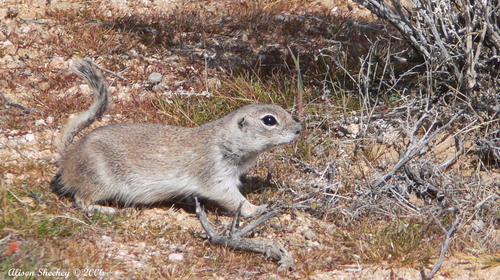
Mohave Ground Squirrel
Xerospermophilus mohavensis
A rare gem of the California desert, the Mohave ground squirrel is a master of timing, emerging for only a few months each year to thrive in one of Earth's harshest environments.
Quick Identification
Size
21-23 cm (8.3-9.1 in) in length; weight 85-130g (3-4.6 oz), significantly heavier before dormancy
Colors
Cinnamon-gray or sandy-brown upper body; creamy white underbelly; tail is dark on top with a white underside
Key Features
- Uniform sandy fur without stripes or spots
- Short, rounded ears that barely protrude from the head
- White underside of tail often held flat against the back
- Small, stocky build typical of desert ground squirrels
When You’ll See Them
Geographic range
Where Does the Mohave Ground Squirrel Live?
Endemic to the western Mojave Desert of North America, the Mohave ground squirrel occupies a surprisingly small footprint within the state of California. Its core range is concentrated in parts of San Bernardino, Los Angeles, Kern, and Inyo counties, particularly within the Antelope Valley and surrounding basins. Unlike its more widespread cousins, this specialist is found nowhere else on Earth, making it a true desert icon of the Southwestern United States.
Basemap © OpenStreetMap contributors
Behavior
The Mohave ground squirrel is a highly specialized desert survivor, best known for its extreme boom-and-bust lifecycle. These squirrels are diurnal and spend a very limited window of time above ground each year. Emerging from their burrows in late winter or early spring, they race to consume enough calories and successfully reproduce before the desert heat becomes unbearable and the vegetation dries up.
By mid-summer, usually around July, these squirrels enter a long period of dormancy known as estivation, which leads directly into winter hibernation. During their active months, they are solitary and territorial, though they communicate with high-pitched whistles to warn of predators. They are cautious but can become accustomed to human presence if their habitat is near low-density residential edges.
EverydayEarth exclusive
Camera Tips
To capture the Mohave ground squirrel, placement is everything. Position your camera at ground level, no higher than 4 to 6 inches, to get an intimate eye-level view of this small mammal. Aim the lens toward the base of saltbush or creosote shrubs, as these squirrels rarely venture into wide-open sandy spaces where they are vulnerable to hawks. If you can find a burrow entrance—look for a clean, semi-circular hole about 2-3 inches wide—set the camera about 3 feet away at a slight downward angle.
In the parched Mojave environment, water is the ultimate lure. A very shallow dish of water placed in front of the camera can attract not just the squirrels, but a variety of desert birdlife. If using bait, native seeds or unsalted sunflower seeds are effective. Because these squirrels are small and move with quick, jerky motions, use a high-sensitivity PIR setting and set your camera to a rapid-fire burst mode or short 10-second video clips to avoid missing the action.
Timing is critical for this species. You will only find them active from roughly March through June. Once the desert vegetation begins to brown in July, they retreat underground and won't reappear until the following spring. Focus your efforts on clear, sunny mornings; they are most active when the ground is warm but before the midday heat becomes extreme. High-speed SD cards are recommended to reduce trigger lag, as these squirrels are surprisingly fast when startled.
Similar Species
Species that look similar or are commonly confused with Mohave Ground Squirrel.
White-tailed Antelope Squirrel
Has a distinct white stripe on its sides and a tail that curls over its back; much more common and active year-round.
Round-tailed Ground Squirrel
Features a longer, more cylindrical tail and is typically found in lower, hotter desert regions further east and south.
California Ground Squirrel
Much larger with a mottled gray/brown coat and a distinct dark 'cape' on its back; prefers less arid environments.
Frequently Asked Questions
Record Mohave Ground Squirrel at your habitat
Connect a camera to start building your own species record — AI identifies every visitor automatically.