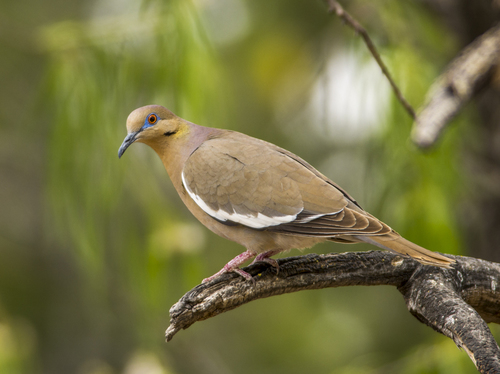
White-winged Dove
Zenaida asiatica
With their striking blue eye-rings and bold white wing patches, White-winged Doves bring a touch of southwestern charm to your backyard. Discover the desert's most melodic visitor through your EverydayEarth camera.
Quick Identification
Size
Length: 11.4 in (29 cm); Wingspan: 18.9-19.7 in (48-50 cm); Weight: 4.4-6.6 oz (125-187 g)
Colors
Soft brownish-gray plumage with a slight purple sheen on the neck; bold white wing patches; vivid blue skin surrounding a red eye.
Key Features
- Distinctive white crescent on the wing edge visible when folded
- Bright blue featherless skin around a red eye
- Square-tipped tail with white corners
- Rhythmic 'who-cooks-for-you' call
When You’ll See Them
Sightings on EverydayEarth
Jun 25, 2026
A White-winged Dove is perched atop a large pile of dry branches and brush. The bird is alert and looking toward the right of the frame, showing its distinctive wing markings.
Jun 25, 2026
Two White-winged Doves are foraging at the base of the wooden feeder. They move across the platform, picking up fallen seeds, with their distinctive white wing patches clearly visible as they shift positions.
Jun 25, 2026
An Acorn Woodpecker clings to the side of the wooden feeder post, scanning its surroundings, while a White-winged Dove stands on the lower feeding platform. The scene is set against a lush backdrop of desert vegetation in the afternoon light.
Jun 25, 2026
A group of White-winged Doves is busy feeding across several stations. At the start, multiple birds cling to a central hanging mesh feeder, while others forage on the lower platform and one perches on the left side of the wooden support. As the scene progresses, several birds drop down from the hanging feeder to join the group on the lower tray, while one remains watchful on the crossbeam.
Jun 23, 2026
A White-winged Dove is perched atop a suet feeder, occasionally looking around at the surrounding brush before leaning down to forage for seeds.
Jun 23, 2026
Three White-winged Doves are gathered around a suet feeder. One bird perches on the horizontal wooden beam, while two others interact with the feeder cage below. Near the end of the sequence, one of the doves on the feeder flies away, displaying its characteristic white wing stripes.
Behavior
White-winged Doves are highly social birds that often travel in large, noisy flocks, particularly during the winter months. Unlike their more timid cousins, they are quite bold in suburban settings and can become the dominant species at a bird feeder. They are famous for their rhythmic cooing, which many residents of the Southwest recognize as the soundtrack of early morning.
These doves are also remarkable for their adaptability. While they were historically desert-dwellers reliant on cactus fruit, they have successfully expanded their range into cities and suburbs across the southern United States. They spend much of their time foraging on the ground or perched prominently on utility lines and high branches, where they keep a keen eye out for predators.
EverydayEarth exclusive
Camera Tips
To capture the best footage of White-winged Doves, place your EverydayEarth camera at a low angle, roughly 6 to 12 inches off the ground, facing a clear patch of dirt or a low-profile tray feeder. These birds prefer feeding on the ground rather than on swinging or hanging feeders. If you set the camera near a scattering of white proso millet or black oil sunflower seeds, you’ll likely see them landing in groups within minutes of the sun coming up.
Water is a massive draw for this species, especially in arid environments. Setting your camera near a ground-level birdbath or a dripping water feature can yield spectacular action shots. They have a unique way of drinking—submerging their beaks and sucking up water like a straw without lifting their heads—which makes for fascinating close-up video content. Ensure your camera is positioned to catch the reflection of the bird in the water for that professional wildlife documentary look.
Lighting is key for highlighting their most beautiful features. Position your camera with the sun at your back to illuminate the brilliant blue skin around their eyes and the subtle iridescent feathers on their necks. Because they are early risers, ensure your camera's 'Dawn' or 'Low Light' settings are optimized. If your camera allows for high-frame-rate recording, use it; their take-off is powerful and produces a distinct whistling sound as the air passes through their wings, which is great to see in slow motion.
Lastly, consider the seasonal movement. During the summer, they are often seen in pairs, providing a great opportunity to capture courtship behaviors like mutual preening or 'bowing' displays. In the winter, they aggregate in large numbers, so widen your camera's field of view to capture the scale of the flock. Avoid placing cameras in high-traffic areas for pets, as these doves are alert and will flush easily if a cat or dog is nearby.
Similar Species
Species that look similar or are commonly confused with White-winged Dove.
Frequently Asked Questions
Record White-winged Dove at your habitat
Connect a camera to start building your own species record — AI identifies every visitor automatically.