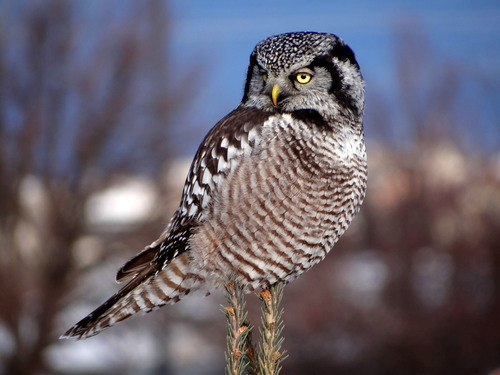
Northern Hawk Owl
Surnia ulula
A daylight hunter with a hawk's silhouette and an owl's soul. With its striking barred belly and fearless gaze, the Northern Hawk Owl is the ultimate prize for winter wildlife watchers.
Quick Identification
Size
Length: 36-45 cm (14-18 in); Wingspan: 71-82 cm (28-32 in); Weight: 240-454 g (8.5-16 oz)
Colors
Brownish-black upperparts with heavy white spotting; creamy white underparts with distinct horizontal brown barring; white face with a prominent black 'V' shaped border; yellow eyes and bill.
Key Features
- Long, falcon-like tapered tail
- Horizontal brown barring across the entire breast and belly
- White facial disk framed by a thick black border
- Flat-topped head with bright yellow eyes
When You’ll See Them
Behavior
The Northern Hawk Owl is a fascinating anomaly in the owl world, behaving more like a diurnal raptor than a creature of the night. Often found perched on the very tip of a lone snag or telephone pole, it spends its daylight hours scanning open ground for movement. It possesses a distinctive upright posture and frequently pumps its long tail up and down when it is alert or preparing to launch into a hunt.
Unlike many other owl species, Northern Hawk Owls are relatively bold and are not easily spooked by human presence, often allowing observers to get quite close. They are highly territorial during the breeding season and are known to dive-bomb any intruders—including humans—that get too close to their nest. Their flight pattern is direct and powerful, characterized by rapid wingbeats followed by long, low glides.
EverydayEarth exclusive
Camera Tips
To capture a Northern Hawk Owl on an AI-powered camera, you must think vertically. These birds are 'top-down' hunters that prefer the highest available perch in an open area. If you have a dead tree or a tall, isolated snag in your yard, this is the primary location for your camera. If no natural perch exists, you can successfully 'bait' them with a perch pole—a 10-to-15-foot sturdy pole placed in an open field with a cross-bar at the top. Mount your camera on a nearby tree or secondary pole at a similar height to catch the bird landing and scanning for prey.
Because these owls are strictly diurnal, you don't need to rely on infrared flash as much as you would for a Great Horned Owl. Set your camera to daytime mode with a high shutter speed. These owls move incredibly fast when they dive, so a slow trigger speed will result in nothing but a blur of feathers. Aim for a trigger speed of 0.2 seconds or faster. If your camera supports burst mode, set it to take 3-5 photos per trigger to ensure you capture the perfect wing position as they land or depart.
Placement is everything. Position your camera so the sun is behind the lens to illuminate the owl's striking facial disk and barred chest. Since Northern Hawk Owls are often attracted to the movement of rodents beneath the snow or grass, placing a second camera near the ground facing an open patch of meadow can capture the dramatic moment of impact. Avoid placing cameras in thick brush; these owls prefer wide-open sightlines where they can see for hundreds of yards.
Lastly, consider the season. In many areas, these owls are only present during 'irruption years' when food is scarce in the Arctic. During these times, they may stay in a single 10-acre area for several weeks. If you spot one in your neighborhood, get your camera out immediately. They are creatures of habit and will often return to the exact same perch every morning between 8:00 AM and 10:00 AM to begin their first hunt of the day.
Similar Species
Species that look similar or are commonly confused with Northern Hawk Owl.
Frequently Asked Questions
Record Northern Hawk Owl at your habitat
Connect a camera to start building your own species record — AI identifies every visitor automatically.