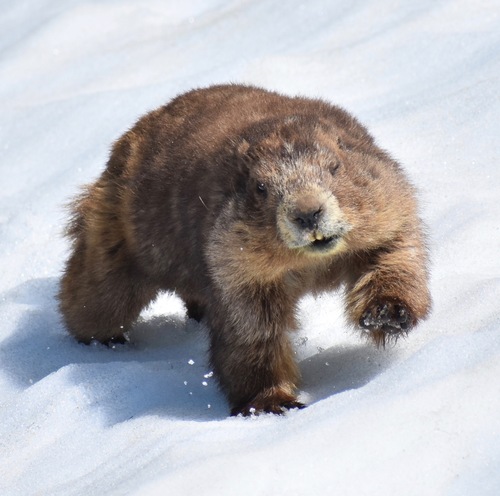
Olympic Marmot
Marmota olympus
The charismatic mascot of Washington's high peaks, the Olympic Marmot is a social, whistling wonder found nowhere else on Earth. Discover how to spot these 'whistle-pigs' among the rocky meadows of the Olympic Peninsula.
Quick Identification
Size
Length: 18 to 28 inches (45–70 cm); Weight: 8 to 24 lbs (3.6–11 kg) depending on hibernation cycle.
Colors
Primarily brownish-gray with a distinct white patch on the bridge of the nose. Their fur often fades to a yellowish-tan or cinnamon color by late summer before they molt.
Key Features
- Stocky, cat-sized body with a flat head
- Bushy, reddish-brown tail
- Small, rounded ears and dark feet
- White patch of fur across the bridge of the nose
When You’ll See Them
Behavior
Olympic Marmots are famous for their gregarious and social nature. Living in close-knit colonies, they often engage in 'nose-to-nose' greetings and play-fighting, which looks like wrestling matches on the alpine slopes. They spend a significant portion of their lives underground in complex burrow systems, coming out primarily to forage and sunbathe on rocks.
These rodents are quite vocal, earning the nickname 'whistle-pigs.' When a predator like a cougar or eagle is spotted, a sentry marmot emits a piercing whistle to alert the colony. While generally wary of humans, those living near popular hiking trails on the Olympic Peninsula can become somewhat habituated, though they should never be fed or approached closely.
EverydayEarth exclusive
Camera Tips
Capturing the Olympic Marmot on camera requires a focus on high-elevation rock outcroppings. Since they are endemic to a very specific region, you won't find them in suburban backyards unless you live on the very edge of the Olympic National Park. Look for 'sun pads'—large, flat rocks near burrow entrances where they bask to regulate body temperature. Position your camera about 12-18 inches off the ground, angled slightly upward to capture them standing on their hind legs, a common scouting posture.
Because these marmots hibernate for up to eight months of the year, timing is everything. Set your cameras out as soon as the snow melts in May or June and pull them before the first heavy snows in October. They are most active during the cooler parts of the day; mid-day heat often drives them back into their cool burrows. Use a fast trigger speed (0.5 seconds or less) to catch them as they scurry between rocks, and consider a burst mode of 3-5 photos to capture their social interactions and 'boxing' behavior.
While baiting is generally discouraged in national parks, you can 'lure' them into frame naturally by placing your camera near a patch of fresh glacier lilies or lupines. Avoid using salt or human food, as this can harm their health and alter natural behaviors. Ensure your camera is secured in a protective security box or 'bear box,' as these curious rodents have been known to chew on plastic casings and straps, and larger predators like black bears frequently patrol the same alpine territories.
Similar Species
Species that look similar or are commonly confused with Olympic Marmot.
Hoary Marmot
Found in the Cascades and Rockies; they have a distinct white patch of fur across their shoulders and a black-and-white face.
Vancouver Island Marmot
Darker, chocolate-brown fur and found exclusively on Vancouver Island, Canada.
Yellow-bellied Marmot
Smaller with a yellowish underside and often found at lower elevations in more arid regions.
Frequently Asked Questions
Record Olympic Marmot at your habitat
Connect a camera to start building your own species record — AI identifies every visitor automatically.