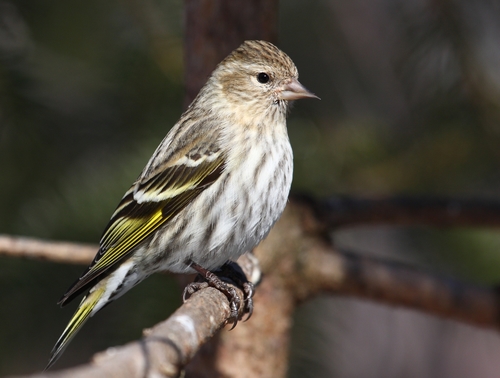
Pine Siskin
Spinus pinus
The Pine Siskin is a whirlwind of energy, often arriving in sudden, massive winter flocks that turn a quiet backyard into a buzzing hub of activity. With their sharp streaks and secret flashes of yellow, these acrobatic finches are a winter favorite for birdwatchers across North America.
Quick Identification
Size
Length: 11-14 cm (4.3-5.5 in); Wingspan: 18-22 cm (7.1-8.7 in); Weight: 12-18 g (0.42-0.63 oz)
Colors
Overall dusky brown with heavy dark streaks on both the back and belly. Subtle flashes of bright yellow on the wing bars and at the base of the tail are more prominent on males, especially during flight or display.
Key Features
- Heavy dark streaking across the entire body
- Sharp, pointed bill narrower than a Goldfinch's
- Yellow patches on wings and base of tail
- Small, notched tail
- Highly social, often found in dense, chattering flocks
When You’ll See Them
Sightings on EverydayEarth
May 2, 2026
Three Pine Siskins are visiting the feeder area. Two are perched on the front tray, actively foraging through the sunflower seeds, while a third remains perched on a pole in the background. The birds are lively, hopping and turning their heads while selecting seeds.
Apr 19, 2026
A small flock of Pine Siskins is actively feeding at the Nyjer seed feeder. Multiple birds are perched at the ports simultaneously, while the wind causes the entire feeder assembly and the neighboring hummingbird and oriole feeders to sway.
Apr 7, 2026
Three Pine Siskins are gathered at the bird feeder tray, actively foraging and pecking at the seeds. They move around the tray, displaying their streaked patterns and flashes of yellow on their wings as they feed.
Apr 2, 2026
A Pine Siskin perches on the edge of the bird feeder tray, actively foraging through the seeds. It moves with quick, purposeful hops, occasionally looking around while selecting sunflower seeds.
Apr 2, 2026
Two Pine Siskins are busy feeding on the tray, their streaked brown feathers and characteristic yellow wing markings clearly visible as they pick through the seeds.
Apr 1, 2026
A Pine Siskin perches on the edge of the copper bird bath, surveying the area. A second Pine Siskin briefly flutters into the frame from the bottom left, showing the characteristic yellow patches on its wings. In the background, a Black-capped Chickadee is active at a hanging tube feeder attached to the pine tree.
Behavior
Pine Siskins are the socialites of the finch world, often appearing in massive, buzzing flocks that can overwhelm a backyard feeder overnight. They are known for their 'irruptive' migration patterns, meaning they may be absent from your area for several years and then suddenly arrive by the hundreds when seed crops fail in the north. They are surprisingly bold around humans but can be quite feisty with other birds, frequently flaring their wings and opening their beaks to defend a prime feeding spot.
During the winter, these birds are in constant motion, fluttering from branch to branch with a distinctive, rising 'zzzzreeeeet' call. Their flight is undulating and acrobatic, often moving as a single cohesive unit when startled. In a backyard setting, they are easily habituated to noise and movement, making them excellent subjects for close-range observation and photography.
EverydayEarth exclusive
Camera Tips
To capture the best footage of Pine Siskins, your camera placement should focus entirely on their preferred food source. Because these birds are small and move in large numbers, a wide-angle lens placed within 2 to 3 feet of a tube feeder filled with nyjer (thistle) or a tray of sunflower hearts is ideal. Position the camera at eye level with the feeder—roughly 5 to 6 feet off the ground—to capture the intricate streaking of their plumage and the flash of yellow in their wings as they jockey for position.
Since Pine Siskins are notoriously fast and jittery, use a high-speed trigger or a video setting with at least 60 frames per second (FPS). This will allow you to slow down the footage to see their acrobatic maneuvers and aggressive 'bill-gaping' displays. If your camera has a 'burst' photo mode, this is the time to use it; catching the exact moment their wings are spread reveals the hidden yellow feathers that are often tucked away while they are perched.
Lighting is crucial for these dusky-colored birds. Try to position your feeder and camera so the morning sun hits the birds directly. This 'front-lighting' will help the camera sensor pick up the subtle details in their brown streaking, which can otherwise look like a dark blur on overcast days. During irruption years, consider setting up a second camera near a heated birdbath, as Siskins are frequent drinkers and bathers, even in sub-freezing temperatures.
Keep in mind that Pine Siskins are susceptible to salmonellosis, which can spread at crowded feeders. If you are using a camera to monitor them, keep a close eye for lethargic birds. For the best (and safest) shots, clean your feeders and the ground beneath them regularly, and perhaps place your camera near a natural 'perching station'—a branch or shrub a few feet from the feeder—where they wait their turn to eat.
Similar Species
Species that look similar or are commonly confused with Pine Siskin.
Frequently Asked Questions
Record Pine Siskin at your habitat
Connect a camera to start building your own species record — AI identifies every visitor automatically.