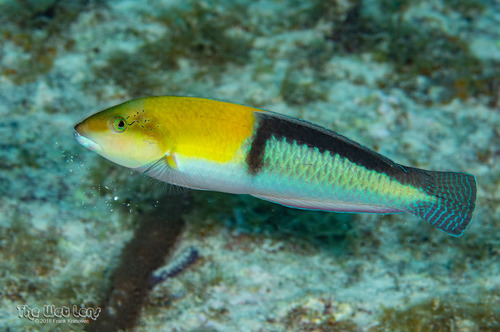
Yellowhead Wrasse
Halichoeres garnoti
A flash of sunshine in the coral, the Yellowhead Wrasse is the Caribbean's most curious reef resident. Watch as these vibrant foragers dart through the waves, transforming from neon-striped juveniles into majestic, tri-colored adults.
Quick Identification
Size
6–8 inches (15–20 cm) in length; rarely exceeding 0.5 lbs (0.2 kg)
Colors
Adults have a bright yellow head transitioning to a dark mid-body band and a green/blue tail. Juveniles are vibrant yellow with a neon blue horizontal stripe.
Key Features
- Bright yellow head and forebody in terminal phase
- Dark vertical bar behind the yellow section
- Juveniles feature a distinct neon blue stripe
- Elongated, cigar-shaped body
- Continuous dorsal fin spanning most of the back
When You’ll See Them
Behavior
The Yellowhead Wrasse is an energetic and inquisitive species, serving as one of the most active daytime residents of the Caribbean reef. They are renowned for their 'shadowing' behavior, where they closely follow larger, sand-disturbing species like goatfish or stingrays to snatch up small invertebrates that are unearthed. Unlike many reef fish that hide in crevices at night, the Yellowhead Wrasse has a unique sleeping habit: it dives into sandy patches near the reef and buries itself completely to stay safe from nocturnal predators.
These fish are protogynous hermaphrodites, meaning they are born female and have the biological capability to transition into a dominant male (terminal phase) if the social hierarchy allows. This transition is accompanied by a dramatic color change from the yellow-and-blue juvenile phase to the multi-colored adult phase. They are generally solitary hunters but are not overly territorial toward divers or cameras, often approaching lenses out of sheer curiosity.
EverydayEarth exclusive
Camera Tips
Capturing the Yellowhead Wrasse requires an underwater camera setup positioned near reef 'edges' where the coral meets the sand. Because these fish are diurnal and most active when the sun is high, lighting is your biggest challenge. Position your camera so the sun is behind it; this prevents the bright yellow of the fish's head from being 'blown out' or silhouetted against the water's surface. A slight downward angle toward the sandy floor is best for capturing their natural foraging behavior.
To guarantee a visit from a Yellowhead Wrasse, utilize their natural curiosity. Gently turning over a small piece of dead coral or stirring a patch of sand immediately before walking away from your camera will almost always draw them in to investigate. They are opportunistic feeders and will dart into the frame to see if you have uncovered any tiny crustaceans. This 'chumming' with sediment is much more effective for this species than using oily fish baits.
Use a high shutter speed or a frame rate of at least 60fps. Wrasses move using their pectoral fins in a fast, 'rowing' motion that can look blurry on standard settings. If your AI-powered camera has a 'pet' or 'small animal' detection mode, ensure it is active, as the erratic, darting movements of the wrasse can sometimes be ignored by sensors tuned for larger, slower-moving marine life like sea turtles.
Mount your camera on a weighted base or a short tripod roughly 12 inches off the seabed. Placing it too high will result in 'top-down' shots that miss the beautiful color transitions on their flanks. Seasonal timing isn't a major factor for this species in the Caribbean, but clearer water days with high visibility will produce the best results for the AI's identification algorithms.
Similar Species
Species that look similar or are commonly confused with Yellowhead Wrasse.
Frequently Asked Questions
Record Yellowhead Wrasse at your habitat
Connect a camera to start building your own species record — AI identifies every visitor automatically.