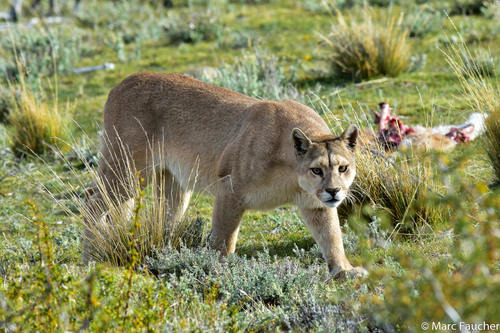
Mountain Lion
Puma concolor
The ultimate master of camouflage, the Mountain Lion is a silent guardian of the American wilderness. From the snowy peaks of the Rockies to the suburban fringes, this powerful predator reminds us of the wild beauty that still hides in plain sight.
Quick Identification
Size
Length: 1.5–2.75 m (5–9 ft) including tail; Height: 60–90 cm (24–35 in); Weight: 30–100 kg (65–220 lbs)
Colors
Uniform tawny, grayish, or reddish-brown coat; cream-colored underbelly; black tips on ears and tail
Key Features
- Extremely long, heavy tail nearly one-third of body length
- Small, rounded head with distinct black 'tear' marks around muzzle
- Large, powerful hind legs built for jumping
- Massive paws with retractable claws and no visible claw marks in tracks
When You’ll See Them
Geographic range
Where Does the Mountain Lion Live?
The mountain lion is the most widely distributed wild land mammal in the Western Hemisphere, native to the vast landscapes of North, Central, and South America. Its range begins in the rugged terrain of the Canadian Yukon and British Columbia, stretching through the American West and down through Mexico into the Amazon basin and the southern tip of Chile. While they were historically found across the entire United States, their core populations are now concentrated west of the Rockies, though they are increasingly being sighted in the Midwest and maintaining a small, isolated population in the Florida Everglades.
Basemap © OpenStreetMap contributors
Behavior
Mountain lions are the ultimate 'ghosts' of the wilderness—solitary, silent, and masterfully elusive. As apex predators, they operate within massive home ranges that can span hundreds of square miles, which they mark with scent scrapes to communicate with other lions. While they are naturally shy and avoid direct human contact, their adaptability allows them to persist even on the fringes of expanding suburban developments where deer populations are high.
These cats are ambush specialists, utilizing dense cover and rocky outcrops to stalk within striking distance of their prey. Despite their large size, they are technically classified as 'small cats' because they cannot roar; instead, they communicate through chirps, whistles, and a chilling scream often compared to a human yell. Socially, they are fiercely independent, with males and females only coming together briefly for mating before the female raises her spotted kittens alone for up to two years.
EverydayEarth exclusive
Camera Tips
To capture a mountain lion on camera, placement is everything. These cats are creatures of habit and efficiency; they prefer traveling along 'lines of least resistance.' Position your camera along narrow ridgelines, old logging roads, or game trails that follow the base of rocky cliffs. Because they are significantly taller than a house cat, mount your camera approximately 24 to 30 inches off the ground. Aiming the camera slightly up a trail (rather than perpendicular to it) gives the sensor more time to trigger, capturing the full body rather than just a tail.
Lighting and stealth are critical for these sensitive felines. Use 'No-Glow' or high-end 'Black Flash' infrared cameras to avoid spooking them with a visible red glow at night. Since they are most active during the crepuscular hours of dawn and dusk, ensure your camera has a high dynamic range (HDR) setting to handle the high-contrast lighting of a forest floor. Set your trigger speed to the fastest possible setting (0.2 seconds or less) and use 'Burst Mode' to take 3-5 photos per trigger, increasing your chances of getting a clear facial shot.
While we never recommend using food bait—as it can dangerously habituate large predators to human areas—natural attractants can be effective. Mountain lions are intensely curious about new smells. Some researchers use a small amount of 'skunk musk' or even a spray of cheap cologne on a nearby log to encourage the cat to pause and investigate, providing a better window for your camera to capture a clear image. Check your camera every few weeks rather than every few days to minimize leaving human scent in their territory.
Similar Species
Species that look similar or are commonly confused with Mountain Lion.
Frequently Asked Questions
Record Mountain Lion at your habitat
Connect a camera to start building your own species record — AI identifies every visitor automatically.