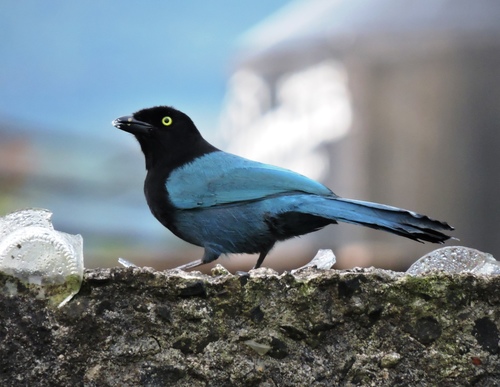
Bushy-crested Jay
Cyanocorax melanocyaneus
With their striking yellow eyes and velvety crests, Bushy-crested Jays are the charismatic socialites of the Central American highlands. These intelligent, vocal birds bring a splash of deep violet color and a wealth of personality to any backyard or forest trail.
Quick Identification
Size
Length: 28-33 cm (11-13 in); Weight: 90-120 g (3.2-4.2 oz)
Colors
Jet black head, throat, and breast; deep violet-blue wings, back, and tail; bright yellow irises
Key Features
- Stiff, bushy crest of feathers on the forehead
- Bright yellow iris contrasting with a dark face
- Rich violet-blue plumage on the body and wings
- Social behavior, usually seen in groups of 5-12
When You’ll See Them
Geographic range
Where Does the Bushy-crested Jay Live?
The Bushy-crested Jay is a resident of the Central American highlands. Its native range begins in the mountains of Guatemala and southern El Salvador, extending across the rugged interior of Honduras and reaching its southern limit in northeastern Nicaragua. These birds are mountain specialists, rarely found in the lowlands, and they thrive in the humid, cloud-kissed forests of the region.
Basemap © OpenStreetMap contributors
Behavior
Bushy-crested Jays are highly social and intelligent corvids that are almost never seen alone. They live in stable family groups, often consisting of a breeding pair and several helpers from previous broods. This cooperative breeding strategy is a hallmark of their behavior, as the entire group works together to defend territory and feed the young. They are remarkably vocal, using a wide array of raspy, metallic calls to communicate with one another as they move through the canopy.
In the wild, they are inquisitive and bold, often investigating anything new in their environment. Their flight is characterized by a series of heavy flaps followed by a glide, and they often move in a 'follow-the-leader' fashion from one tree to the next. While they spend much of their time in the middle and upper levels of the forest, they are not shy about descending to the ground or garden feeders to investigate food sources.
EverydayEarth exclusive
Camera Tips
To capture the best footage of Bushy-crested Jays, place your camera at a mid-range height, ideally between 5 and 8 feet. These birds are frequent visitors to forest edges and clearings, so mounting your camera on a tree overlooking a garden or a fruit-bearing shrub is a winning strategy. Because they are social and often travel in groups, use a wider-angle lens setting if available to capture the interaction between multiple individuals rather than just a single bird.
Attracting them to your camera site is relatively easy if you provide a food incentive. A platform feeder stocked with suet, large seeds, or native fruits like bananas or papayas will act as a magnet for a local flock. They are also very fond of water; a elevated birdbath or a trickling water feature can provide excellent opportunities for 'action' shots as they bathe and socialise. Since they are intelligent and can be wary of new objects, it is best to leave your camera in place for several days to let them acclimate to its presence.
Proper lighting is essential for showing off their beautiful plumage. Their violet-blue feathers can appear dull or black in deep shade, so try to position the camera in an area that receives soft, indirect morning light. This will highlight the iridescence of their wings and make the bright yellow of their eyes pop on camera. Set your trigger speed to the fastest possible setting, as these jays are highly active and rarely sit still for long, often twitching their tails and hopping between branches.
Similar Species
Species that look similar or are commonly confused with Bushy-crested Jay.
Azure-hooded Jay
Has a striking light-blue crown and nape, whereas the Bushy-crested Jay has an entirely black head.
White-throated Magpie-Jay
Much larger with an extremely long tail and a white throat and underparts.
Black-throated Jay
Features a smaller crest and a blue-topped head, living in similar high-altitude habitats but with distinct plumage patterns.
Frequently Asked Questions
Record Bushy-crested Jay at your habitat
Connect a camera to start building your own species record — AI identifies every visitor automatically.