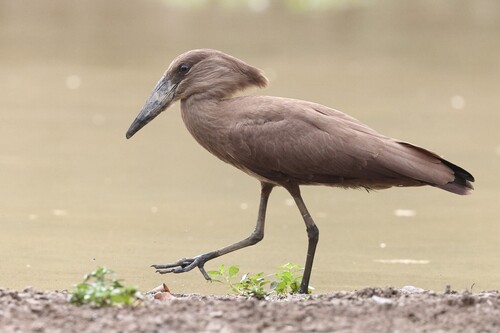
Hamerkop
Scopus umbretta
Meet the Hamerkop, the master architect of the African wetlands. Easily recognized by its hammer-shaped silhouette, this unique bird builds some of the largest nests in the avian world.
Quick Identification
Size
Length: 50–56 cm (20–22 in); Wingspan: 90–94 cm (35–37 in); Weight: 415–570 g (0.9–1.3 lb)
Colors
Uniform sepia-brown plumage with a faint purple sheen on the wings. Legs and bill are black.
Key Features
- Distinctive hammer-shaped head with a long backward-pointing crest
- Large, heavy, straight bill
- Broad wings and a relatively short tail
- Medium-sized, stocky brown body
When You’ll See Them
Sightings on EverydayEarth
Jul 25, 2026
In the center of a wide waterhole, a Hamerkop is perched on the back of a partially submerged hippopotamus. The water is calm, reflecting the bright sky and scattered clouds of a sunny morning.
Jul 17, 2026
A single Hamerkop is perched at the edge of the watering hole. It remains largely motionless, occasionally shifting its head to scan the water and surroundings for potential prey.
Jul 15, 2026
A Hamerkop is positioned at the left edge of the water hole, standing perfectly still while scanning the shallows for prey. The bird's unique profile is visible against the light-colored bank. The scene is quiet, with no other significant wildlife activity during the observation period.
Jul 15, 2026
A Hamerkop flies into the frame and lands on the far bank of the watering hole. It stands at the water's edge, occasionally moving its head, revealing its characteristic silhouette. The scene is bright and sunny with very little wind.
Jul 12, 2026
A Hamerkop is perched on the left edge of the watering hole at the start of the clip. It takes flight almost immediately, flying toward the left. In the background, other small birds are seen flying across the pond through the bright morning light.
Jul 3, 2026
A Hamerkop is perched on the bank of the watering hole, standing still while surveying the water for prey. It occasionally adjusts its stance and turns its head.
Geographic range
Where Does the Hamerkop Live?
The Hamerkop is native to the African continent, found extensively throughout Sub-Saharan Africa from the southern edge of the Sahara down to the Cape. It is also a common sight across the island of Madagascar and inhabits the coastal wadis and wetlands of the southwestern Arabian Peninsula, including Yemen and Saudi Arabia. While it remains within its native range year-round, it may move locally to find permanent water sources during particularly dry seasons.
Basemap © OpenStreetMap contributors
Recorded on EverydayEarth
Behavior
The Hamerkop is a fascinating, largely sedentary bird known for its extraordinary architectural skills. Unlike most birds that build nests just large enough for their eggs, Hamerkops construct massive, domed structures made of thousands of sticks, grass, and mud. These nests can reach over 1.5 meters in diameter and are strong enough to support the weight of a person. They often build multiple nests a year, regardless of whether they are breeding, which provides homes for various other species like owls and honeybees once vacated.
In the wild, they are social and often seen in pairs or small groups, particularly during elaborate social displays known as 'false mounting' or 'ceremonies.' During these displays, birds run around each other, calling loudly and raising their crests. Despite their busy social lives, they are efficient hunters, often seen wading through shallow water or standing perfectly still on the backs of hippos to gain a better vantage point for prey.
EverydayEarth exclusive
Camera Tips
Capturing a Hamerkop on a backyard or trail camera requires a focus on shallow water. If you have a garden pond or live near a stream, place your camera on a small tripod or mount it to a stake just 30–50 cm (12–20 inches) above the ground. Angle the lens toward the muddy edge or a flat 'landing rock' where the bird might stand to scan for frogs. Hamerkops are crepuscular, meaning they are most active during the dim light of dawn and dusk, so ensure your camera's infrared (IR) flash is fast and the trigger speed is under 0.5 seconds to capture them as they strike at prey.
Because Hamerkops are creatures of habit, they often return to the same foraging spot daily. Look for 'whitewash' (droppings) on rocks or logs near the water, which indicates a regular perching site. If you are targeting their famous nest-building behavior, position your camera at a distance with a wide-angle view. These nests are huge and usually located in the fork of a large tree or on a cliff side. A time-lapse setting can be particularly effective here, as it can condense weeks of stick-carrying and construction into a fascinating video sequence.
In suburban environments, Hamerkops are often attracted to the sound of running water or the presence of goldfish. If your camera allows, use a high-frame-rate video setting (60fps or higher). This will help you see their unique 'foot-stirring' technique in slow motion, where they vibrate their feet on the pond floor to flush out hiding frogs. During the rainy season, keep your camera batteries fresh, as the abundance of frogs often leads to a massive spike in Hamerkop activity and many more 'trigger events' per day.
Similar Species
Species that look similar or are commonly confused with Hamerkop.
Shoebill
Much larger (1.2m tall), grey plumage, and lacks the backward-pointing head crest.
Grey Heron
Larger with a much longer neck and legs; lacks the hammer-shaped head silhouette and brown coloring.
Black-crowned Night Heron
Similar size and crepuscular habits, but has grey and white plumage with a black cap rather than uniform brown.
Frequently Asked Questions
Record Hamerkop at your habitat
Connect a camera to start building your own species record — AI identifies every visitor automatically.