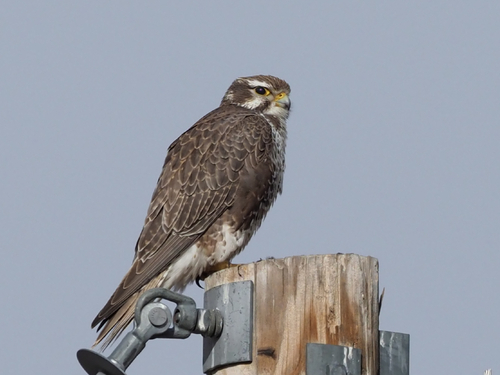
Prairie Falcon
Falco mexicanus
The ghost of the sagebrush, the Prairie Falcon is a master of speed and stealth in the arid West. With its sandy plumage and fierce disposition, it thrives where other raptors falter.
Quick Identification
Size
Length: 14.5-18.5 in (37-47 cm); Wingspan: 35-44 in (90-113 cm); Weight: 1.1-2.4 lbs (500-1,100 g)
Colors
Sandy-brown upperparts with pale edges; creamy-white underparts with dark spotting or streaking; dark brown 'armpit' feathers (axillaries) visible in flight.
Key Features
- Dark 'armpits' (axillaries) visible during flight
- Sandy or earthy-brown plumage, paler than a Peregrine
- Narrow dark 'mustache' stripe on the face
- Long tail and relatively blunt-tipped wings
When You’ll See Them
Sightings on EverydayEarth
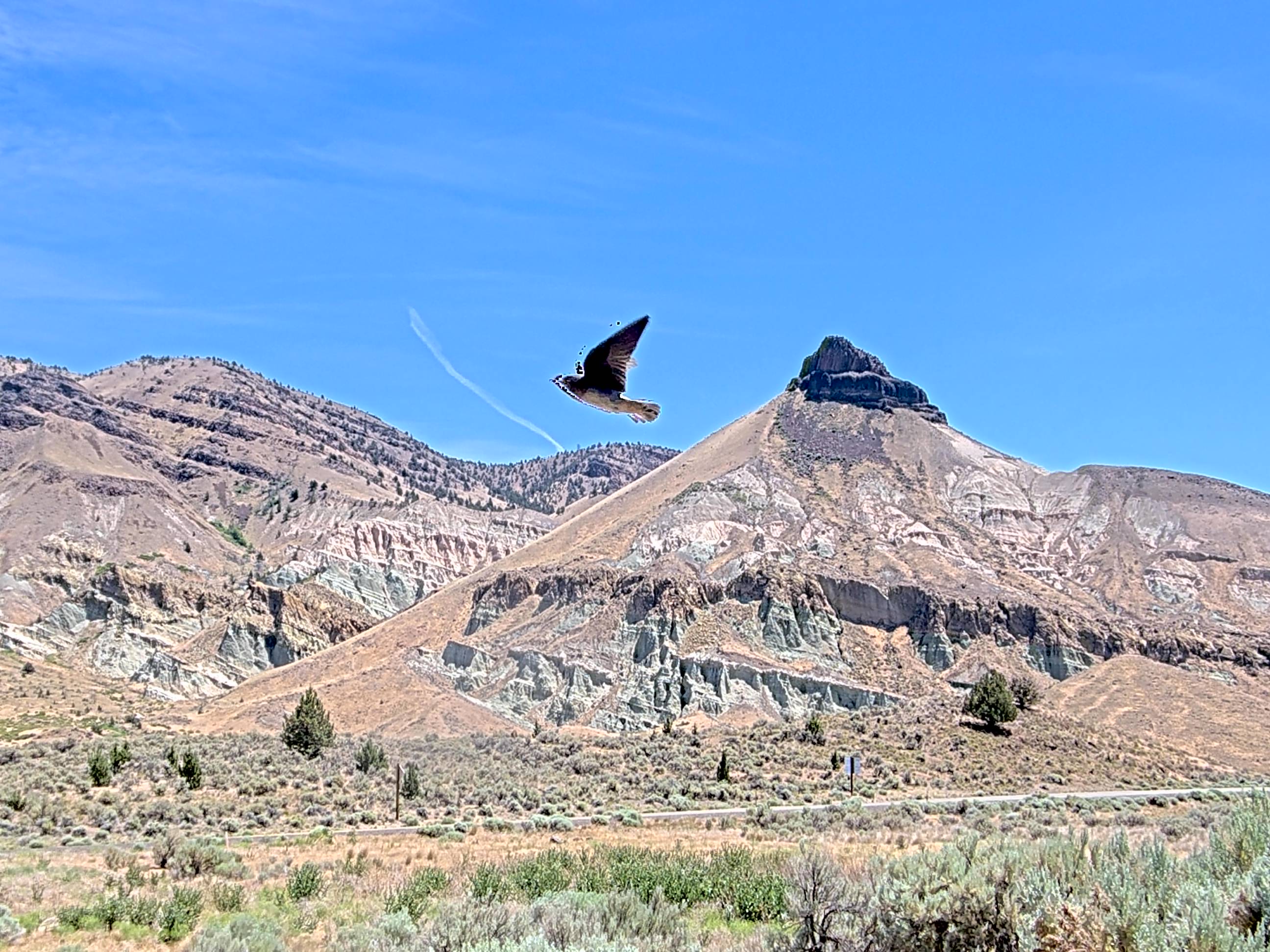
Jun 16, 2026
A Prairie Falcon is captured mid-flight, soaring across the bright blue sky above the volcanic landscape of Sheep Rock. The bird's pointed wings and characteristic facial markings are visible against the backdrop of the fossil-rich cliffs.
Behavior
The Prairie Falcon is a rugged specialist of the American West, built for the high-intensity demands of arid environments. Unlike many other falcons that dive from great heights, the Prairie Falcon often hunts using a technique called 'hedge-hopping,' flying low to the ground and utilizing natural contours or bushes to surprise its prey. They are incredibly aggressive and territorial, known to drive away much larger raptors like Golden Eagles or Red-tailed Hawks from their nesting cliffs.
While they are solitary for much of the year, they form strong pair bonds during the breeding season, typically nesting on high cliff ledges or 'potholes.' In the winter, they may move into agricultural areas or even suburban fringes where songbirds and rodents are more concentrated. They are opportunistic and tenacious, often pursuing prey with a dogged persistence that sets them apart from the more aerial-focused Peregrine Falcon.
EverydayEarth exclusive
Camera Tips
To capture a Prairie Falcon on a trail camera, you must think like a desert hunter. These birds favor high, isolated vantage points that offer a 360-degree view of their hunting grounds. If you have a property with open acreage, look for solitary fence posts, utility poles, or large rocks. Mounting your camera 4 to 6 feet high on a nearby post and angling it toward these prominent perches is your best bet. Because they are incredibly fast, ensure your camera has a 'trigger speed' of 0.2 seconds or faster. Use the 'Burst Mode' setting to capture a series of photos, as the most diagnostic feature—the dark feathers under the wing—is often only visible during take-off or landing.
Water is a magnet for Prairie Falcons in dry climates. If you have a large, ground-level birdbath or a stock tank, place your camera overlooking the water's edge. They are more likely to visit for a drink or a bath during the heat of the afternoon. When setting up near water, position the camera to the north of the target area to keep the sun at your back, which prevents the bright western sun from blowing out the details of the falcon's sandy plumage. High-resolution video settings (1080p or 4K) are recommended to help distinguish them from similar-looking raptors.
In the winter months, these falcons often move toward agricultural fields or areas with high rodent activity. If you notice a high concentration of ground squirrels or wintering songbirds, that is exactly where you should place your equipment. Since they aren't attracted to traditional birdseed, you are essentially 'baiting' the camera with the environment itself. Keep your PIR (Passive Infrared) sensor sensitivity on 'High' to ensure the camera triggers for these fast-moving birds even at a distance, and consider a fast shutter speed setting if your camera allows it to reduce motion blur during their characteristic low-level flybys.
Similar Species
Species that look similar or are commonly confused with Prairie Falcon.
Peregrine Falcon
Darker, slate-gray plumage with a much broader, darker facial 'helmet' and lacks the dark underwing armpits.
Merlin
Much smaller (pigeon-sized) with a more streaked face and lacks the sandy-brown tones of the Prairie Falcon.
American Kestrel
Significantly smaller with bright rufous (reddish-brown) tones on the back and tail, and two distinct black stripes on the face.
Frequently Asked Questions
Record Prairie Falcon at your habitat
Connect a camera to start building your own species record — AI identifies every visitor automatically.